
Table of Contents
Summary
Internet marketing as a whole is undergoing its most significant transformation in a decade. The rise of Large Language Models (LLMs) like Google’s Gemini, OpenAI’s ChatGPT, and xAI’s Grok have changed the rules for winning organic traffic. This shift makes traditional Search Engine Optimization (SEO) strategies lacking.
Generative Engine Optimization (GEO) emerges as the necessary evolution of SEO. Its primary goal is not to rank a link, but to have one’s content, data, and brand directly cited as the authoritative source within the AI-generated answer. This report outlines a comprehensive framework for GEO, built upon six core pillars:
- Deep Website Architecture: Structuring a site logically to signal expertise to machines.
- High-Intent Content: Creating precise, authoritative content that targets users in the decision-making phase.
- Digital PR & Authority: Building web-wide trust through mentions, links, and press.
- Social & UGC Engagement: Participating in the real-time conversations that fuel LLMs.
- Structured Data Mastery: Communicating unambiguously with machines via Schema and other standards.
- Modern KPI Tracking: Shifting measurement from rankings to AI visibility and citation impact.
This article provides a detailed analysis of each pillar, offers actionable strategy tips, and presents a concluding set of recommendations for businesses aiming to secure their AI visibility and authority in the new age of LLM and AI-driven search. Success requires a holistic strategy that combines technical precision with high-quality content and web-wide trust signals, ensuring your organization becomes the definitive source for the answer engines of tomorrow.
SEO and GEO Trends
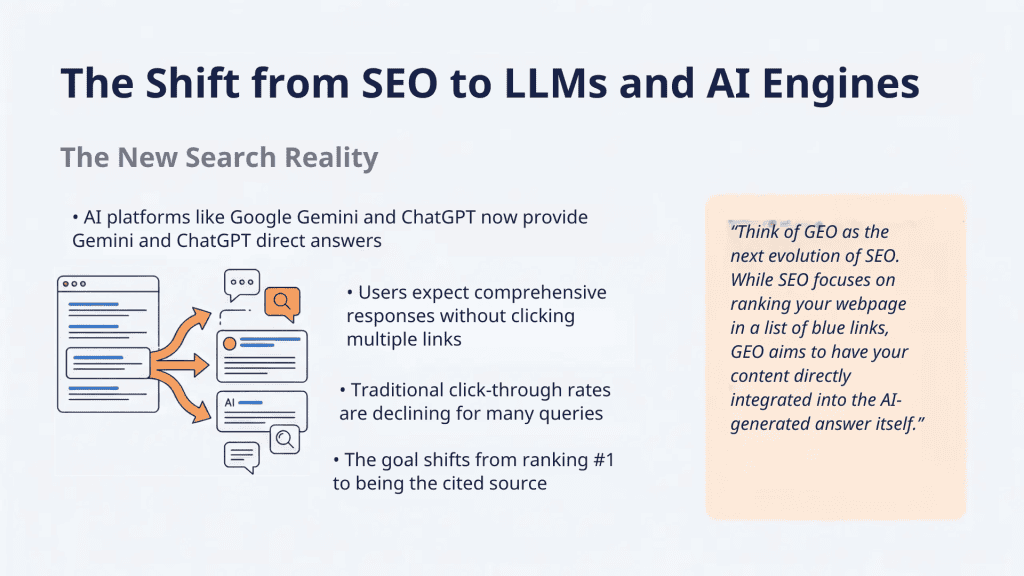
For over two decades, the goal of search marketing has been clear: achieve the highest possible rank on a Search Engine Results Page (SERP). In 2026, this foundational objective is being fundamentally challenged. The rapid, widespread adoption of conversational AI has created a new user expectation, one that favors direct, comprehensive answers over a list of links to be explored. This is the era of the Answer Engine, and it demands a new strategy: Generative Engine Optimization (GEO).
Battle of the Acronyms (AEO, GEO, and LLMO)
Several acronyms have emerged to describe this new field. I’ll list the most common, but understand they all refer to the same thing, which is doing “SEO” for AI responses wherever they are presented.
- AEO (Answer Engine Optimization or AI Engine Optimization)
- GEO (Generative Engine Optimization)
- LLMO (Large Language Model Optimization)
For the sake of simplicity, I will simply refer to this as “GEO” or “LLM Visibility” going forward.
Think of GEO as the next evolution of SEO. While SEO primarily focuses on ranking your webpage in a list of blue links, GEO aims to have your content, facts, and brand directly integrated into the AI-generated answer itself.
Why Tracking LLM Traffic and Visibility Matters Right Now
Before we dig into the tracking methods, we need to talk about why this matters. Because I’ve seen too many marketers dismiss AI traffic as a rounding error. That’s a mistake.
AI Traffic Converts Better Than Traditional Search
Think about how a visitor gets to your site from Google versus ChatGPT.
Google: someone types a keyword, scrolls past a wall of blue links, maybe clicks yours. They’re shopping around. Comparing. Kicking tires.
ChatGPT or Perplexity: someone asks a specific question and gets a direct recommendation. “What’s the best fire protection company in Omaha?” and the model names a brand, explains why, and drops a link. That visitor shows up pre-sold. They just need to see your phone number.
That’s high-intent traffic by default. The data backs it up too. Across multiple client accounts, AI referral channels are posting engagement rates and conversion rates that match or beat organic search. Some accounts I’ve seen come back at nearly 60% engagement rate from LLM traffic. That’s not a rounding error. That’s a channel you need to be watching.
AI Visibility Lifts More Than One Channel
Here’s the part most people miss.
When someone sees your brand recommended by an LLM, they don’t always click the citation link. A lot of them open a new tab, Google your brand name, or type your URL directly.
That means AI visibility is quietly driving traffic to your Direct and Organic Search channels too. The spillover effect is real and, according to data from Cairrot’s research on AI traffic patterns, it’s at least 2x stronger than what you’d expect from traditional SEO brand lift.
So if you’re only looking at the AI row in your analytics, you’re seeing maybe half the picture.
Forget “Rankings.” Think “Visibility.”
In traditional SEO, you track positions. Rank #1 for “Omaha SEO company.” Rank #3 for “WordPress speed optimization.” Clean. Simple. Linear.
AI search doesn’t work that way.
There’s no fixed list. No positions 1 through 10. Every time someone asks a question, the model generates a fresh response. Your brand might show up in 6 out of 10 answers today, 3 out of 10 tomorrow, and 8 out of 10 next week. It depends on the prompt, the model, and the context window.
The right metric isn’t “rank.” It’s Visibility: a combination of mention rate, citation frequency, share of voice against competitors, and actual referral traffic from LLMs.
Great GEO Is Still Built on Great SEO
Let me be clear. GEO (Generative Engine Optimization) isn’t replacing SEO. It’s an expansion of it. Like building a second story on a house that already has a solid foundation.
LLMs are trained on web content. They pull from the same authoritative sources that Google values. If your SEO foundations are weak (thin content, bad site structure, no original research, no branded assets) your AI visibility will be weak too.
The businesses winning in AI search right now are the ones that already have strong SEO fundamentals and are layering GEO-specific strategies on top. I’ll cover those strategies later in this guide.
3 Ways to Track LLM Traffic to Your Website
There are several ways to measure how much traffic LLMs are sending your way. Here are three methods, ranked from most manual to most comprehensive.
Method 1: Track LLM Traffic in GA4 (The Manual Way)
This is the DIY approach. Free, uses data you already have. You just need to set up a custom channel group so GA4 properly categorizes AI referral traffic instead of lumping it into “Referral” or “Unassigned.”
Here’s the quick version:
- In your GA4 property, go to Admin > Custom Channel Groups
- Clone your Default Channel Group
- Add a new channel and label it AI Traffic (or AI / LLM)
- Set the condition to “Source matches regex” and paste this:
(chatgpt|openai|anthropic|deepseek|grok)\.com|(gemini|bard)\.google\.com|(perplexity|claude)\.ai|(copilot\.microsoft|edgeservices\.bing)\.com|edge\scopilot
- Save, then click Reorder and move AI Traffic above “Referral” in the priority list
That’s it. Ten minutes and you’ve got a dedicated AI traffic channel in your reports.
The good: Free. Uses data you already have. Quick setup.
The catch: Doesn’t scale across multiple properties. Only shows traffic volume. No visibility data, no competitive intelligence, no way to track how often LLMs mention your brand. And you’ll need to manually update that regex every time a new LLM source enters the market.
For a more detailed walkthrough with screenshots, Cairrot’s guide on AEO metrics walks through each step.
Method 2: Free Looker Studio Dashboard (Quick Visual)
If you don’t want to touch GA4 settings and just want a quick snapshot, there’s a free Looker Studio LLM Traffic template that pulls AI referral data from your GA4 property automatically.
Connect your GA4 and you’ll have a visual dashboard you can screenshot, share with clients, or throw into a report.
The good: Free. Fast. Visual.
The catch: Not scalable. If you’re managing multiple client accounts (like I do), you’re not setting up separate dashboards for each one. No competitive data, no visibility metrics, no automation. Think of it like a thermometer. It tells you the temperature, but not whether a storm is coming.
Good for a quick sanity check. Not a long-term solution.
Method 3: Use a Dedicated GEO Analytics Platform (Most Comprehensive)
If you’re serious about AI search as a channel, and after reading the data above you should be, a purpose-built tool is the move.
Platforms like Cairrot integrate directly with your GA4 and Google Search Console to surface AI Traffic reports automatically. No regex hacking. No manual channel groups. No Looker Studio templates that break when Google changes their API.
What you get with a dedicated platform:
- LLM Provider Breakdown: Sessions, engaged sessions, key events, and average duration broken out by source. Know exactly how ChatGPT traffic compares to Gemini, Claude, or Perplexity.
- Top Pages from AI Traffic: Which pages are LLMs actually sending people to? This tells you what content is getting cited and driving clicks.
- AI Sessions Over Time: Trend lines with period-over-period comparisons. This is how you prove growth to stakeholders or clients.
- Full Channel Comparison: AI / LLM traffic side-by-side with Organic, Direct, Paid, Social, and every other channel so you can put AI search performance in context.
One thing I like about Cairrot specifically is their open data philosophy. All your data is accessible via API. Pull it into your own dashboards, pipe it into your reporting stack, export it however you want. No walled gardens.
The good: Automated. Comprehensive. Tracks traffic + visibility + competitive data in one platform. Scales across clients and properties.
The catch: Requires a paid subscription. But pricing starts under $40/month for basic tracking, and under $100/month for multi-LLM coverage. Compared to the manual hours or the blind spots of free tools, the ROI math is pretty straightforward.
How to Track “Rankings” in LLMs
This is where it gets interesting. And where most marketers get tripped up.
Why LLM “Ranking” Isn’t What You Think It Is
In Google, rank is simple. Position #1 means your URL is the first organic result. Position #7 means you’re buried on the lower half of the page. Easy to track. Easy to understand.
AI search doesn’t have positions.
When someone asks ChatGPT “What are the best WordPress SEO companies?”, the model generates a new answer from scratch every time. There’s no fixed list. The brands it mentions, the order it puts them in, whether it includes citations at all, all of it can vary between queries.
So when a client asks “What’s my rank in ChatGPT?”… the honest answer is: it depends on the prompt, the model version, the user’s conversation history, and sometimes just plain randomness in how the model generates its response.
What you can measure is how frequently your brand appears across a consistent set of prompts over time. That’s Visibility.
The Only Way to Track LLM Visibility Over Time
There’s no free hack for this one. No GA4 workaround. No Looker Studio template.
Tracking how often your brand appears in LLM responses across multiple models, multiple prompts, over weeks and months requires a tool that’s actively querying those models on a schedule and recording the results.
This is exactly what Cairrot and a handful of other LLM visibility tracking tools are built to do. Here’s what the reporting looks like in practice:
- Model x Competitors Heatmap: See how your brand stacks up against competitors across every major LLM. Gemini. Claude. GPT. Perplexity. DeepSeek. All in one view.
- Topic x Competitors Heatmap: Go deeper than model-level. Which topics does your brand own? Where are competitors gaining ground? This is how you prioritize your content calendar.
- Visibility Trend Charts: Visibility over time so you can see whether your GEO efforts are actually moving the needle. Think of it as the AI search equivalent of watching your keyword rankings climb in Ahrefs or Semrush.
You can’t improve what you can’t measure. If you’re going to invest in GEO (and the next section of this guide will show you how), getting baseline visibility data is step one.
The Six Pillars of a Successful GEO Strategy
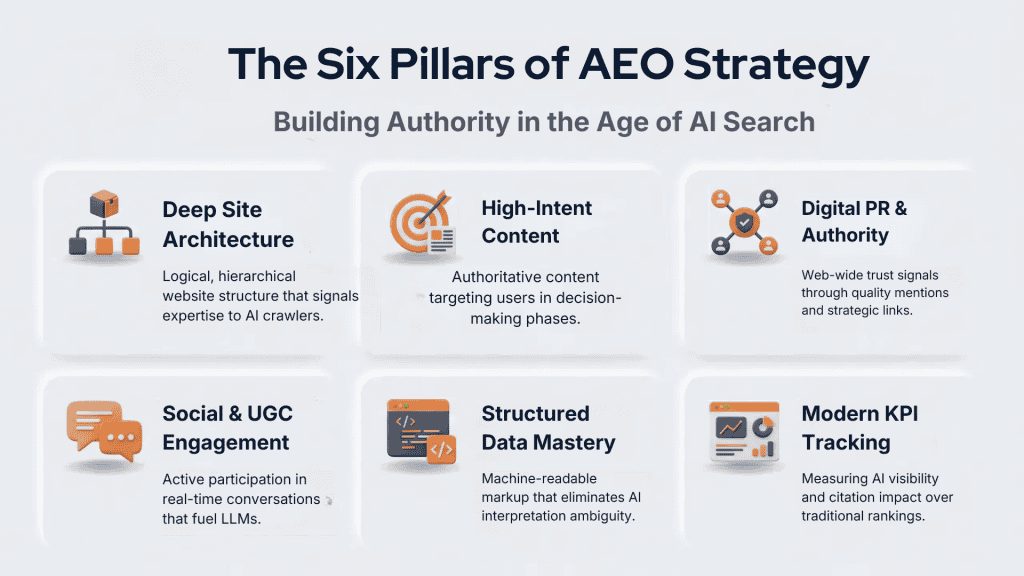
A robust GEO strategy is not a single tactic but a multi-faceted approach. It integrates technical precision, high-quality content, and strategic outreach. The following six pillars form the foundation of a successful GEO campaign. Note that many pillars and strategy examples shared in the following section were either given to me, or verified to be accurate by Connor Kimball, the CEO of Cairrot who has access to more LLM visibility data than 99.99% of marketers in the world.
Pillar 1: Foundational Site Architecture
Your website structure is the bedrock of GEO. An LLM cannot recognize you as an authority if your site is a disorganized collection of pages. A deep, logical, and hierarchical structure is essential to signal expertise. For example, an industrial company like Titan Steel Structures excels by having granular pages for every product, use-case, and industry served, creating an unambiguous map of their expertise for crawlers. This structure naturally targets high-intent, long-tail keywords and captures users further down the buying funnel.
Pillar 2: High-Intent, Authoritative Content
GEO content must be precise, factual, and directly answer user questions. The priority should be on “high-intent” content that targets users actively evaluating solutions. This includes formats that consistently drive conversions, such as direct competitor comparisons, detailed industry pricing guides, and how-to content that solves a problem using your product. The goal is to create the definitive resource that an AI engine would confidently choose as its source. Listicles, price guides, competitor comparisons, and results/testimonial content are especially effective for winning AI citations.
Pillar 3: Digital PR for Authority Building
Answer engines rely on web-wide signals of trust to validate information. Digital Public Relations, including link building and media mentions, provides these signals. When a reputable website links to your content, it acts as a vote of confidence. A steady stream of press releases announcing product launches or market research injects your brand’s narrative into the news ecosystem, a primary source for many LLMs. I personally notice that Gemini is especially reactive to press release content.
Pillar 4: Social Media Content
Real-time answer engines like Grok heavily rely on public discussions on platforms like X and Reddit to understand current events and sentiment. Your social media presence is a critical data source for GEO. The strategy is not to spam links, but to become a genuinely helpful participant. Answering questions on Reddit or publishing insightful threads on X positions your brand as an authority in the spaces where real human conversations are happening.
Pillar 5: Structured Data
If content is what you say, structured data is how you say it in the language of machines. Schema markup is a vocabulary that allows you to explicitly tell an answer engine: “This is a product, this is its price, this is its SKU, and this person is the author of this technical article.” This removes ambiguity and is essential for being correctly interpreted and featured. Emerging standards like llms.txt may further refine this machine-to-machine communication (though there is no evidence that llms.txt currently affects LLM citations).
Pillar 6: Tracking and KPIs (LLM Visibility)
Measuring GEO success requires a new toolkit and mindset. Traditional KPIs like keyword ranking are becoming vanity metrics in a world of click-less answers. The new focus must be on visibility and influence within the AI responses themselves. Key metrics now include:
- AI Brand Visibility (Share of Voice): How often your brand is cited in AI answers for target queries.
- LLM Clicks: Traffic driven from links within an AI-generated answer.
- Branded Mentions: The raw count of your brand name appearing in AI responses.
7 Actionable Tips for GEO Implementation
Embarking on an GEO strategy can feel daunting. The key is to start with high-impact tactics that build a strong foundation. Here are seven actionable tips drawn from proven GEO strategies to begin optimizing for the age of AI search.
- Develop Solutions and Use-Case Pages. Move beyond generic “Features” pages. Create dedicated landing pages that target how specific customer segments use your product or service. A page titled “Project Management Software for Marketing Teams” is far more powerful for GEO than a simple feature list. It directly answers a high-intent query, signals expertise in a specific vertical, and captures users who are actively seeking a solution for their unique problem, making it a prime candidate for an AI recommendation.
- Create High-Conversion Topic Clusters. Focus your content efforts on topic clusters that intercept users at the final stages of the buying journey. The two most powerful formats are competitor comparisons (“[Your Product] vs. [Competitor A]”) and industry price guides. These pages must be genuinely helpful and balanced, not just sales pitches. By transparently addressing the questions every buyer has about cost and alternatives, you establish trust and become the most authoritative source on the topic.
- Build an Interactive Tool or “Link Magnet”. The best GEO asset is a free, valuable tool that solves a real problem for your audience. For a telecom company, this could be a “Monthly Bill Calculator.” For marketers, a tool like iPullRank’s QFA (Questions, Facts, and Answers) tool is invaluable. These assets provide immense user value, naturally attract high-quality backlinks (a powerful authority signal), and position your brand as an innovative leader worthy of citation.
- Systematize Digital PR with Press Releases. Treat press releases as a strategic tool for injecting your desired narrative into the web’s information ecosystem. Regularly publish releases about new products, partnerships, research findings, or company milestones. Each release should link back to relevant pages on your site with varied anchor text. For a large B2B brand, a frequency of one release every 2-3 months maintains a steady drumbeat of authority signals for LLMs to consume.
- Leverage X (Twitter) Threads for Real-Time Relevance. With xAI’s Grok using X as its primary real-time data source, the platform has become a direct channel to an answer engine. Don’t just post links. Transform your expertise—blog posts, data, industry insights—into engaging, multi-post threads. This format is highly readable for both humans and AI, feeding directly into Grok’s knowledge base and establishing your profile as a go-to authority on your topics, often with near-instantaneous impact.
- Implement Granular Schema Markup. Speak the language of machines with precision. Go beyond basic Organization schema. For a SaaS product, use SoftwareApplication schema to detail application categories, pricing, and compatibility. For an industrial product, use Product schema with the additionalProperty attribute to specify every technical detail, from model number to capacity. For articles, nest Author schema to link content to a real expert. This level of detail removes all ambiguity for an LLM, making your entity the clearest and most logical choice to feature.
- Adopt “AI Visibility” as a Core KPI. You cannot improve what you do not measure. Shift your reporting focus away from traditional rank tracking. Invest in or demand tools that can actively query answer engines and report on your “Share of Answer.” Tracking how frequently your brand is cited for your most important keywords is the single most important measure of GEO success. This metric aligns your efforts with the new reality of search and provides a true north for your strategy.
Recommendations for Tracking LLM Visibility and Implementing GEO
Generative Engine Optimization is already here as a top marketing channel whether you are prepared for it or not. The decline of click-through rates and the rise of direct AI answers represent a fundamental disruption to the digital marketing landscape. Businesses that continue to rely solely on traditional SEO tactics risk becoming invisible to a growing segment of users.
Success in this new frontier requires a holistic, integrated strategy built on the six pillars of GEO. It demands a shift in mindset from chasing rankings to building verifiable, machine-readable authority. By combining a logical site structure, high-intent content, strategic PR, social engagement, and technical precision, organizations can position themselves to be the trusted source for the answer engines of today and tomorrow.
Recommendations:
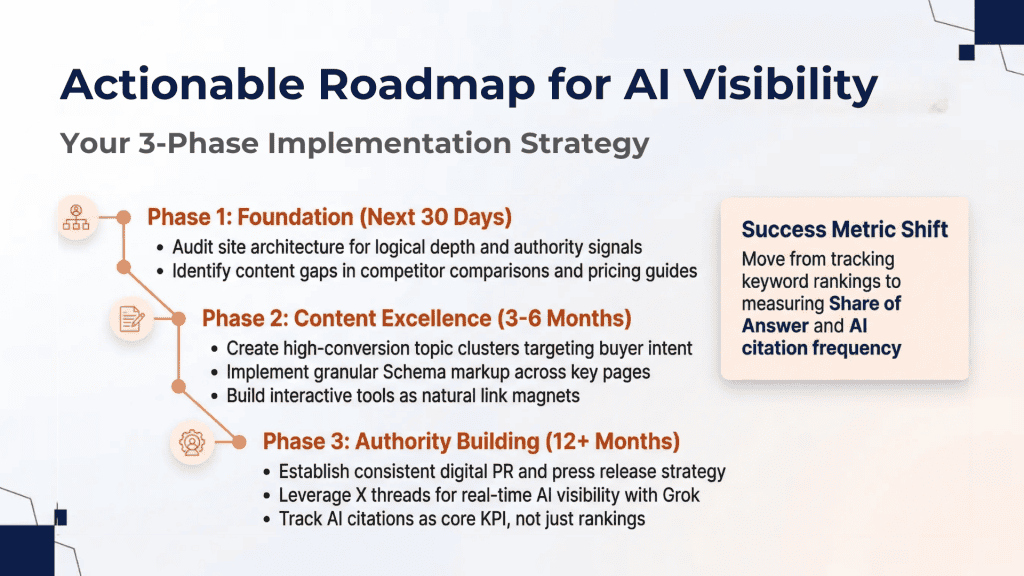
- Immediate Action (Next 30 Days): Conduct a comprehensive audit of your existing website. Evaluate your site architecture for logical depth and your content library for high-intent assets. Identify immediate gaps where you are not answering critical user questions about your solutions, competitors, and pricing.
- Short-Term Plan (3-6 Months): Prioritize the creation of a high-conversion topic cluster, focusing on a detailed competitor comparison page and an industry pricing guide. Simultaneously, implement foundational and product-specific Schema markup across your highest-value pages. For more insights on this, resources like The Best SEO Podcast often cover emerging tactics. The most recent episode featured Connor Kimball, who spent most of the show sharing AI Search tactics.
- Long-Term Strategy (12+ Months): Develop a sustained digital PR and content repurposing plan to consistently build authority signals. Integrate social media efforts, particularly on X and LinkedIn, into your GEO strategy. Finally, invest in a modern GEO analytics platform to track AI Visibility and other meaningful KPIs, moving beyond outdated metrics.
The search landscape is dynamic. How will you adapt your strategy to ensure your brand is not just found, but featured?
Learn More About LLM SEO Services
If you’re a forward thinking business that understands the value of ranking in LLMs like ChatGPT, Grok, and Gemini, then we are here to help. Our top-rated LLM SEO / GEO services are helping service-based businesses around the country find more customers online without paying for expensive ads or referral fees. Contact us today to learn more ->


 Follow Our RSS Feed
CONNECT WITH US!!