I’ve been optimizing websites since you had to submit your URL to a directory and wait. Every few years, someone declares that SEO is dead, and every few years the discipline absorbs whatever supposedly killed it and keeps moving. GEO is the latest version of that story, and it’s the most legitimate one yet.
Generative Engine Optimization isn’t a rebrand. It isn’t a buzzword designed to sell a new retainer. It’s a measurable shift in how information gets discovered, and for the first time in decades, the tracking and reporting frameworks most SEO professionals rely on aren’t equipped to capture it. That’s the real problem. Not whether GEO matters. It does. The problem is that most of us don’t have a reporting stack that proves it.
This guide is for SEO professionals and agency operators who need to add GEO metrics to their reporting without burning the whole thing down. I’ll walk through what GEO actually changes about our work, which metrics hold up under client scrutiny, how to track them across the major AI platforms, and where Cairrot fits if you need a tool that doesn’t require an enterprise contract to get started.
Table of Contents
Key Takeaways
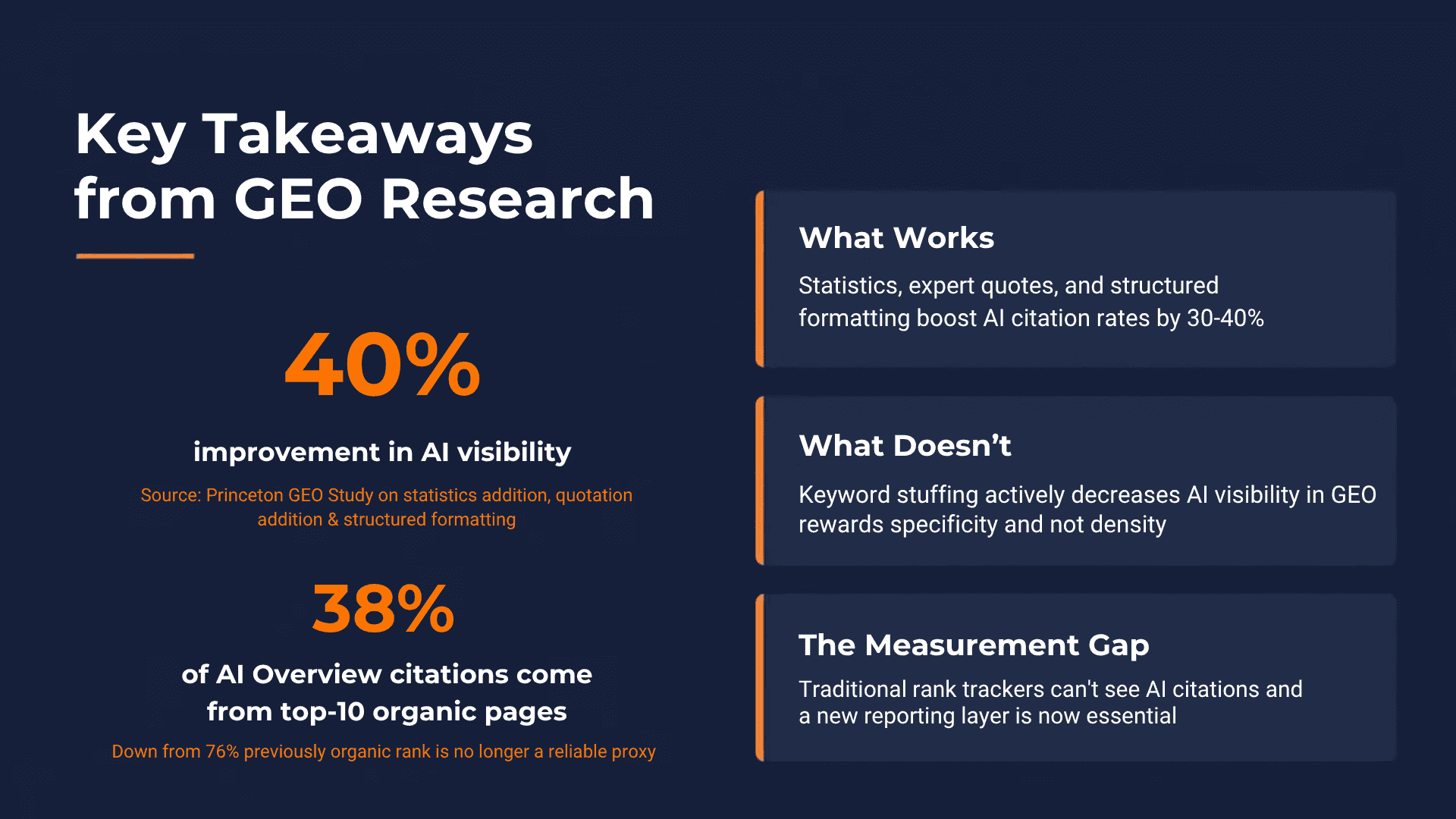
- GEO is not replacing SEO. It’s extending it into a channel that traditional rank trackers can’t see.
- The Princeton research showed that GEO-specific optimization techniques (statistics addition, quotation addition, structured formatting) improved AI visibility by up to 40%. Keyword stuffing performed worse than the baseline.
- The metrics that matter for GEO reporting are citation share, brand mention rate, share of voice, sentiment, and AI referral traffic with conversion attribution.
- Each AI platform (ChatGPT, Perplexity, Claude, Gemini, Grok) retrieves and cites differently. Reporting needs to reflect that, not flatten it.
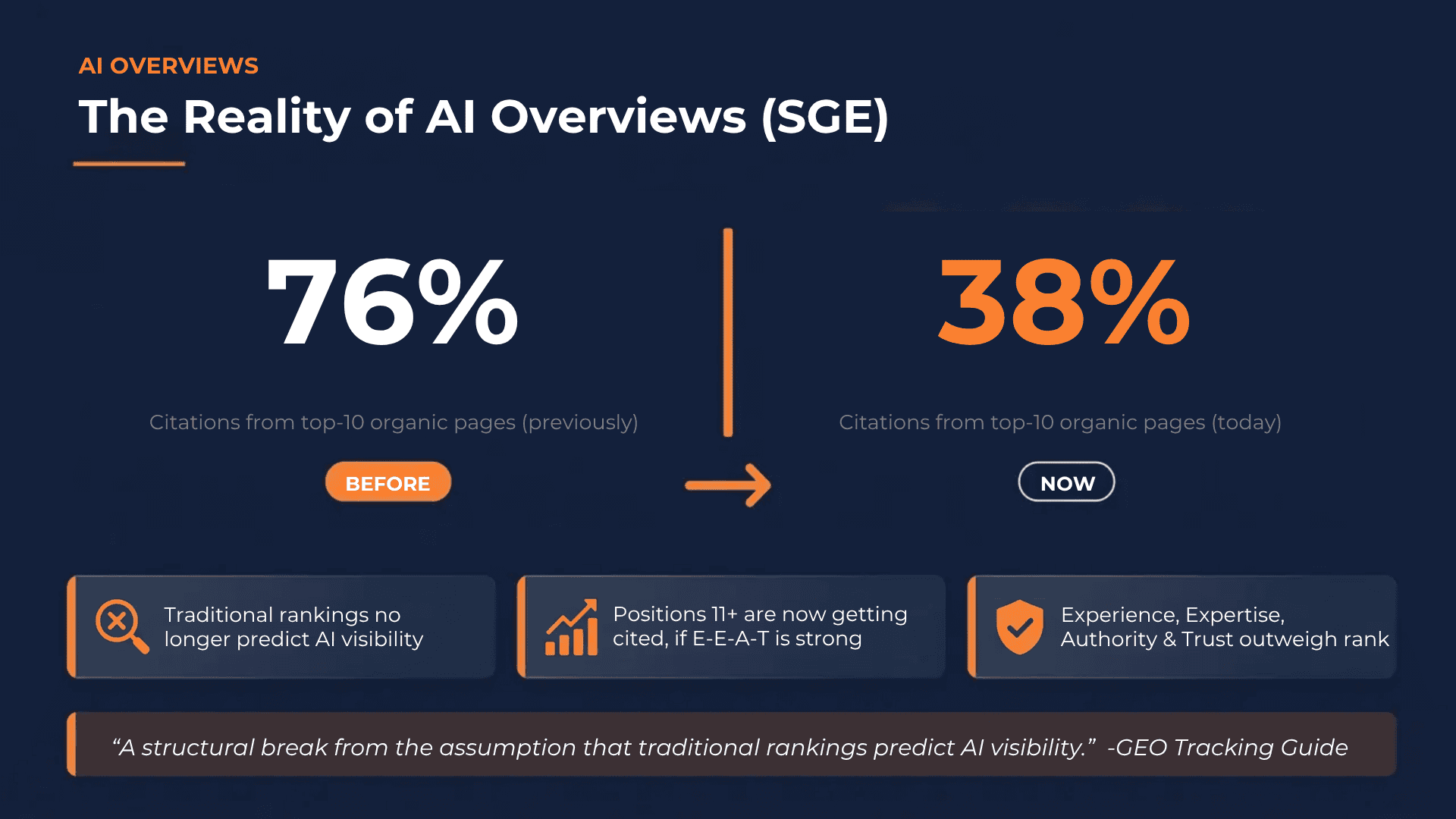
- Only 38% of AI Overview citations now come from top-10 organic pages, down from 76% previously. Traditional rankings are a weaker proxy for AI visibility than most of us assumed.
- GEO tracking is still early enough that the professionals who build reporting frameworks now will own the client conversation for years.
Where GEO Sits in the SEO Landscape Right Now
Let’s address the elephant. Google’s John Mueller weighed in on the GEO debate in early 2026 and essentially said: it’s probably not a separate framework, but you do need to understand how discovery is changing. Gary Illyes made a similar point at Search Central Live, emphasizing that AI features share infrastructure with traditional Search.
They’re not wrong. And they’re not entirely right either.
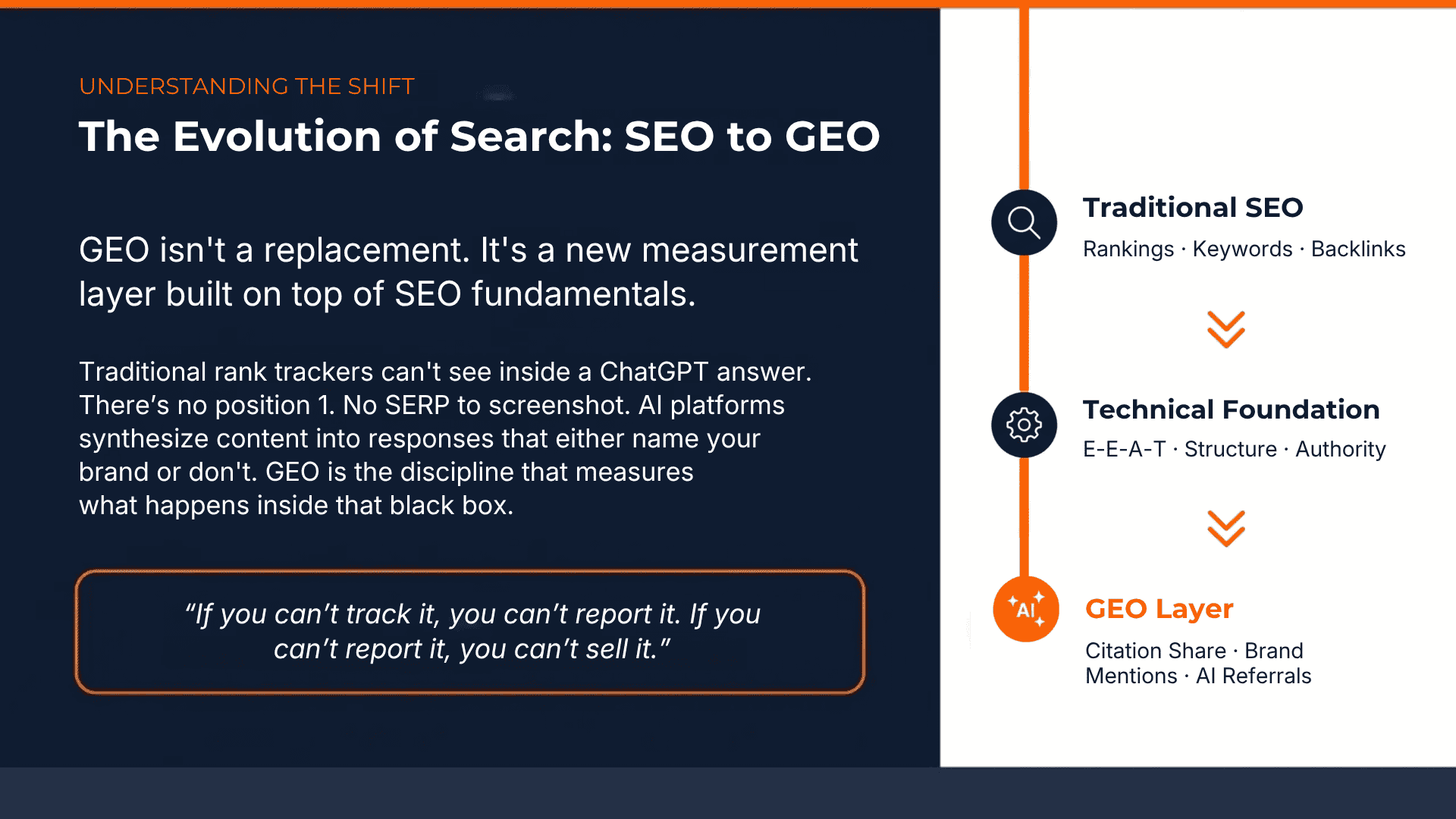
Here’s where I land on it after watching this space for the last two years: GEO and SEO share a foundation. Structured content, technical soundness, authority signals, E-E-A-T. If your SEO fundamentals are solid, you’re ahead of most competitors in AI visibility too. The Princeton study confirmed this. The research showed that traditional SEO tactics like keyword stuffing actually decreased AI visibility, while adding verifiable statistics, expert quotations, and structured formatting boosted it by 30 to 40%.
But the measurement layer is completely different. There’s no “position 1” in a ChatGPT answer. There’s no SERP to screenshot. The output is a synthesized paragraph that either names your brand or doesn’t, cites your page or a competitor’s, and characterizes your business in language you didn’t write. If you can’t track that, you can’t report on it. And if you can’t report on it, good luck selling it to a client.
That’s the gap GEO fills. Not a new optimization discipline so much as a new measurement discipline layered on top of SEO fundamentals we’ve been refining for 20 years.
The GEO Metrics That Survive Client Scrutiny
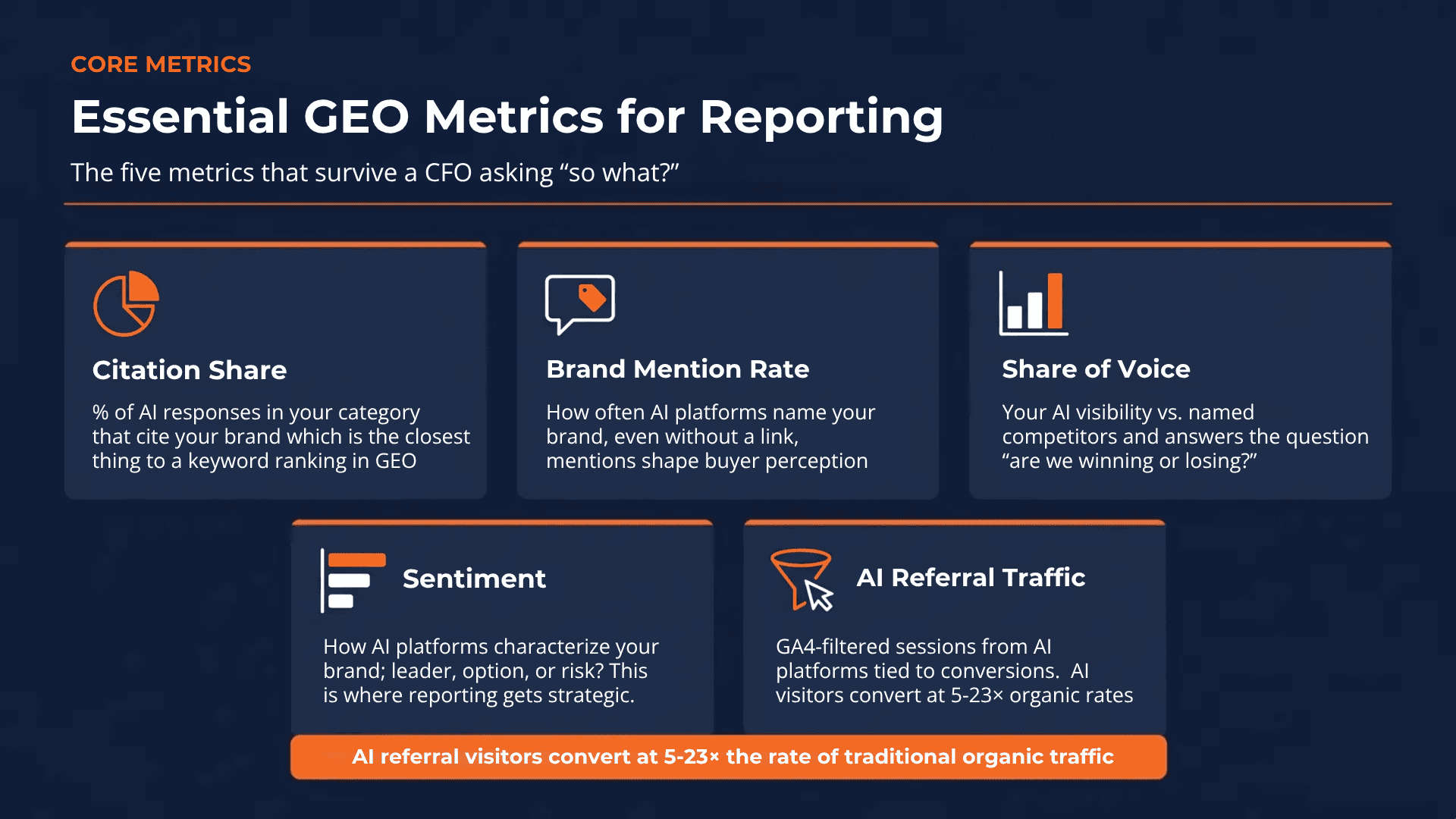
If you’ve been doing agency SEO for any length of time, you know the difference between a metric that sounds impressive in a slide deck and one that survives a CFO asking “so what?” Here are the GEO metrics that hold up.
Citation Share is the closest thing to a keyword ranking in GEO. Of all the AI-generated responses in your client’s category, what percentage cite your client? Track it across platforms, by query cluster, and over time. This is the metric that shows trajectory and competitive positioning. If your client holds 15% citation share this month and 22% next month, that’s a story worth telling.
Brand Mention Rate tracks how often AI platforms mention the brand by name, regardless of whether they link to a specific page. This matters because a mention without a citation still influences the buyer’s perception. When ChatGPT says “companies like [Client Name] offer this type of service,” that’s a positioning win even if no link appears.
Share of Voice compares your client’s AI visibility against named competitors. It answers the question every client eventually asks: “Are we winning or losing?” Build this as a rolling comparison across the prompt clusters that map to your client’s revenue-driving keywords.
Sentiment measures how AI platforms characterize the brand. Positive, neutral, negative. Are they being described as a leader, an option, or a risk? This is where GEO reporting gets genuinely strategic. If Perplexity consistently positions your client as “affordable but limited,” that’s a messaging problem you can fix with content, and you can show the fix in next month’s report.
AI Referral Traffic with Conversion Attribution closes the loop. Filter GA4 for traffic from chat.openai.com, perplexity.ai, claude.ai, gemini.google.com, and grok.com. Then tie those sessions to conversions. The volume is still small for most sites, but the conversion quality is remarkable. Multiple studies have found AI referral visitors converting at 5 to 23 times the rate of traditional organic, depending on the vertical. That’s the number that makes a CFO lean forward.
How Each AI Platform Handles Citations (and Why It Matters for Reporting)
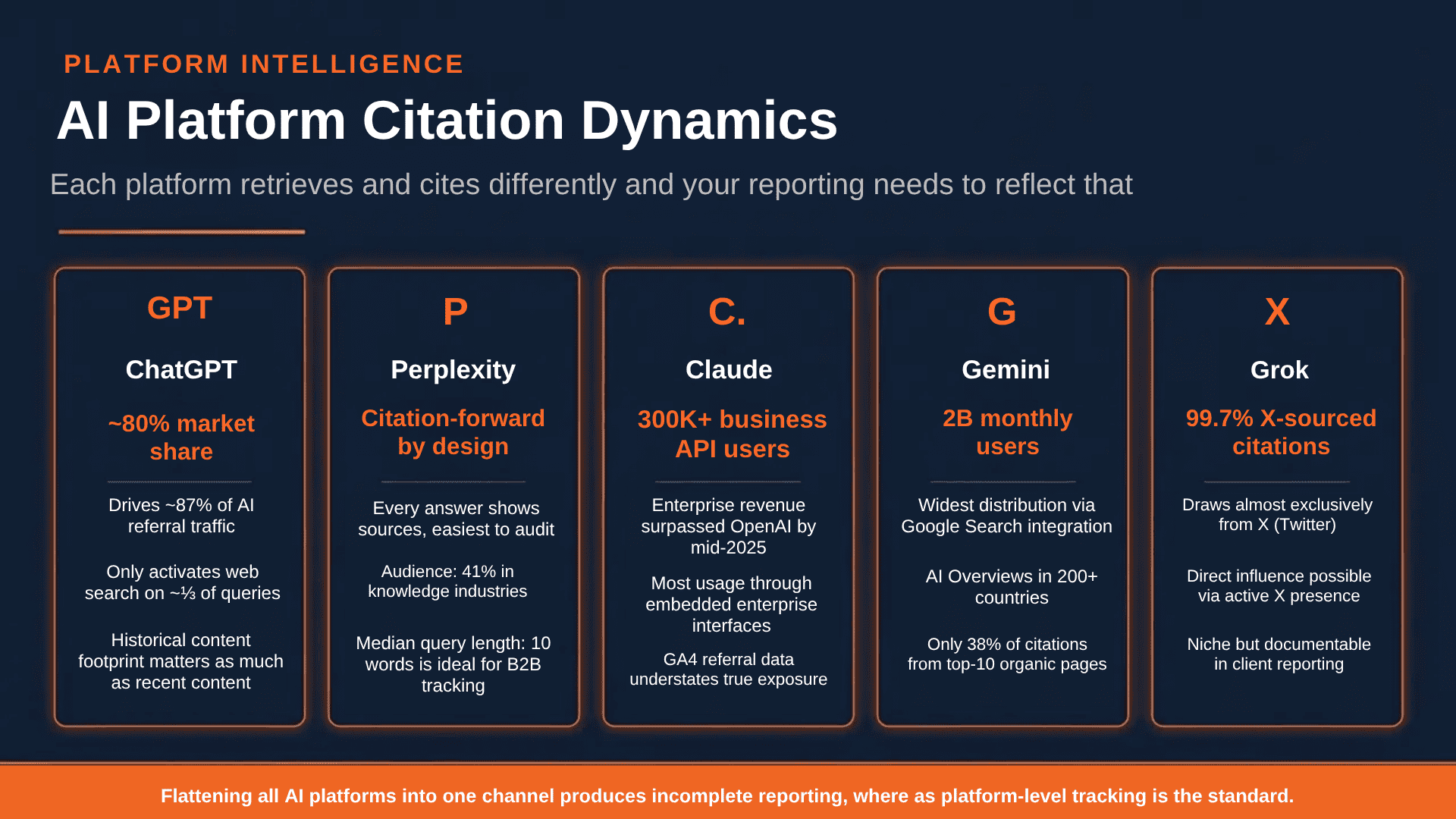
One of the biggest mistakes I see in early GEO reporting is treating all AI platforms as one channel. They’re not. Each model retrieves content differently, weights authority differently, and surfaces citations differently. Your reporting needs to reflect that.
ChatGPT dominates volume. It holds roughly 80% of the AI chatbot market and drives about 87% of all AI referral traffic. But it only activates web search on about a third of queries. The rest pull from training data, which means your historical content footprint matters as much as what you published last week. Wikipedia accounts for nearly half of ChatGPT’s top cited sources for factual queries, which tells you something about the authority threshold it applies.
Perplexity is citation-forward by design. Every answer shows its sources, making it the easiest platform to audit for citation presence. The audience skews heavily toward researchers and professionals (41% in knowledge industries, median query length of 10 words). For B2B clients, Perplexity citation tracking is non-negotiable. We wrote a full Perplexity tracking guide if you want the detailed methodology.
Claude punches above its consumer numbers in enterprise. Over 300,000 businesses use the API, and Anthropic’s enterprise revenue reportedly surpassed OpenAI’s by mid-2025. The challenge is that most Claude usage happens through embedded enterprise interfaces, not the public web app. GA4 referral data will understate actual exposure. Prompt-level monitoring through a dedicated tool is the only way to get an accurate picture.
Gemini has the widest distribution of any AI platform thanks to its integration with Google Search. AI Overviews now reach 2 billion monthly users across 200+ countries. The critical finding for SEO professionals: only 38% of AI Overview citations come from top-10 organic pages, down from 76% in earlier analyses. That’s a structural break from the assumption that traditional rankings predict AI visibility. Content with strong E-E-A-T signals from positions 11 and beyond is getting cited. Track your clients’ AI Overview appearances separately from their organic rankings.
Grok draws almost exclusively from X (formerly Twitter) for social citations. One study found that 99.7% of X-sourced citations across AI platforms came specifically from Grok. If your client has an active X presence, Grok is a visibility channel you can influence directly. If they don’t, that’s a gap worth documenting in your reporting, even if the recommendation is to deprioritize it for now.
Building a GEO Reporting Framework That Doesn’t Require Enterprise Pricing
Here’s the practical part. Most agencies I know aren’t going to drop $2,000 a month on a new platform to test a channel that currently drives under 2% of traffic. Fair. Here’s how to build a functional GEO reporting layer without destroying your margins.
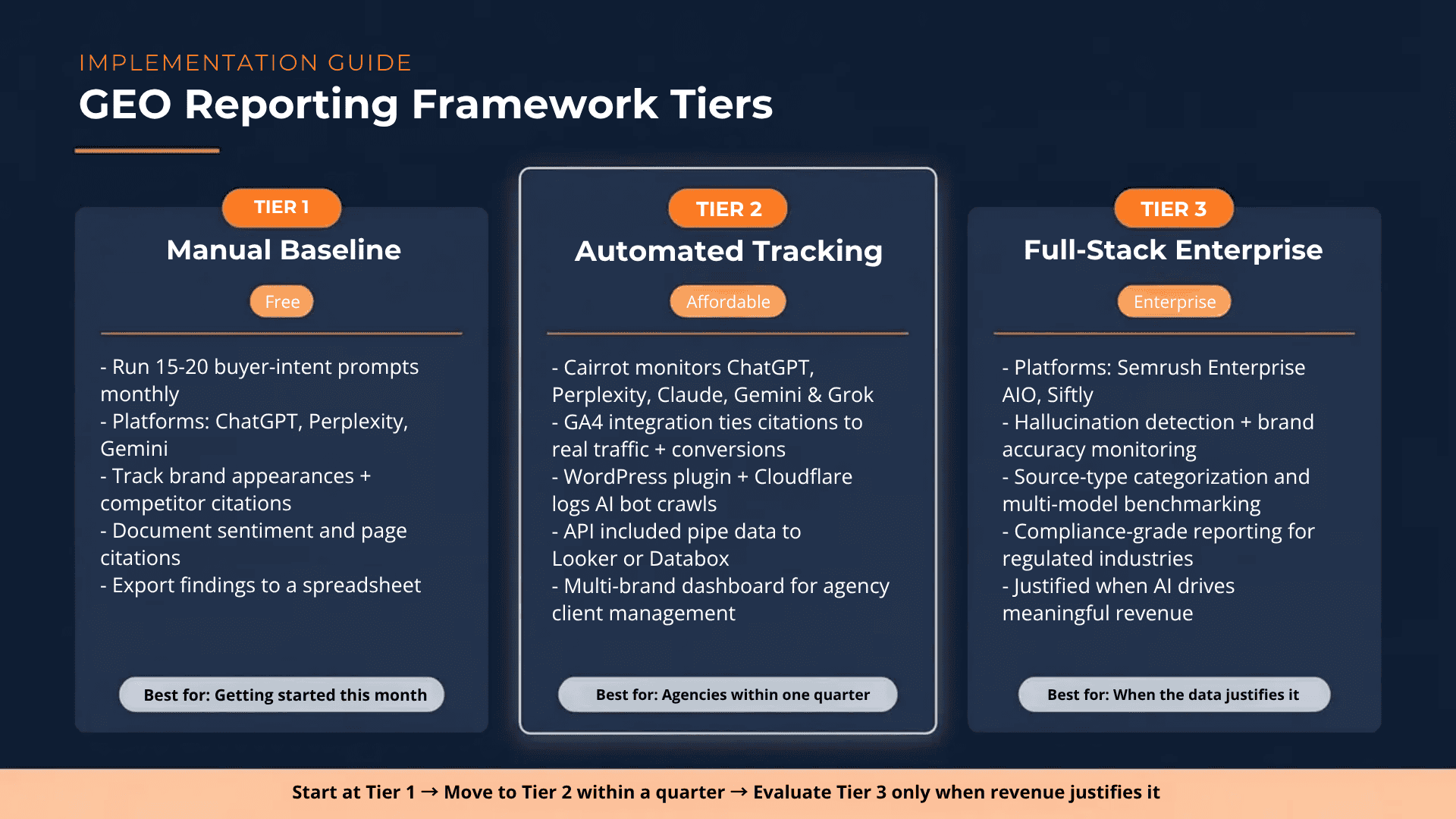
Tier 1: Manual Baseline (Free)
Run 15 to 20 buyer-intent prompts through ChatGPT, Perplexity, and Gemini. Document whether your client’s brand appears, which pages get cited, who the competitors are in each answer, and how the brand is characterized. Do this monthly. Export to a spreadsheet. This gives you a baseline and a narrative, which is often all a client needs to start caring about the channel.
Tier 2: Automated Tracking (Affordable)
Cairrot was built for this tier. It monitors visibility across ChatGPT, Perplexity, Claude, Gemini, and Grok from a single dashboard. The GA4 integration ties citation data to real traffic and conversions. The WordPress plugin and Cloudflare integration log AI bot crawls so you can see which platforms are actively reading your client’s site. And the API is included on all plans, which means you can pipe the data into Looker, Databox, or your own white-label dashboards without paying for an enterprise upgrade.
For agencies managing multiple clients, Cairrot’s multi-brand interface keeps everything organized without switching between accounts. EWR Digital did a solid comparison of AEO tracking tools if you want to see how options stack up side by side.
Tier 3: Full-Stack GEO (Enterprise)
Platforms like Semrush’s Enterprise AIO, Siftly, and others offer deeper analytics including hallucination detection, source-type categorization, and multi-model competitive benchmarking. These make sense when AI referral traffic represents a meaningful revenue line or when clients operate in regulated industries where brand accuracy in AI responses has compliance implications.
Most agencies should start at Tier 1 this month, move to Tier 2 within a quarter, and evaluate Tier 3 only when the data justifies it.
What GEO-Optimized Content Actually Looks Like
Going through theory is a nice way to understand GEO, but let’s talk about what to build.
The Princeton research gave us a data-backed starting point. The optimization methods that moved the needle weren’t clever hacks. They were:
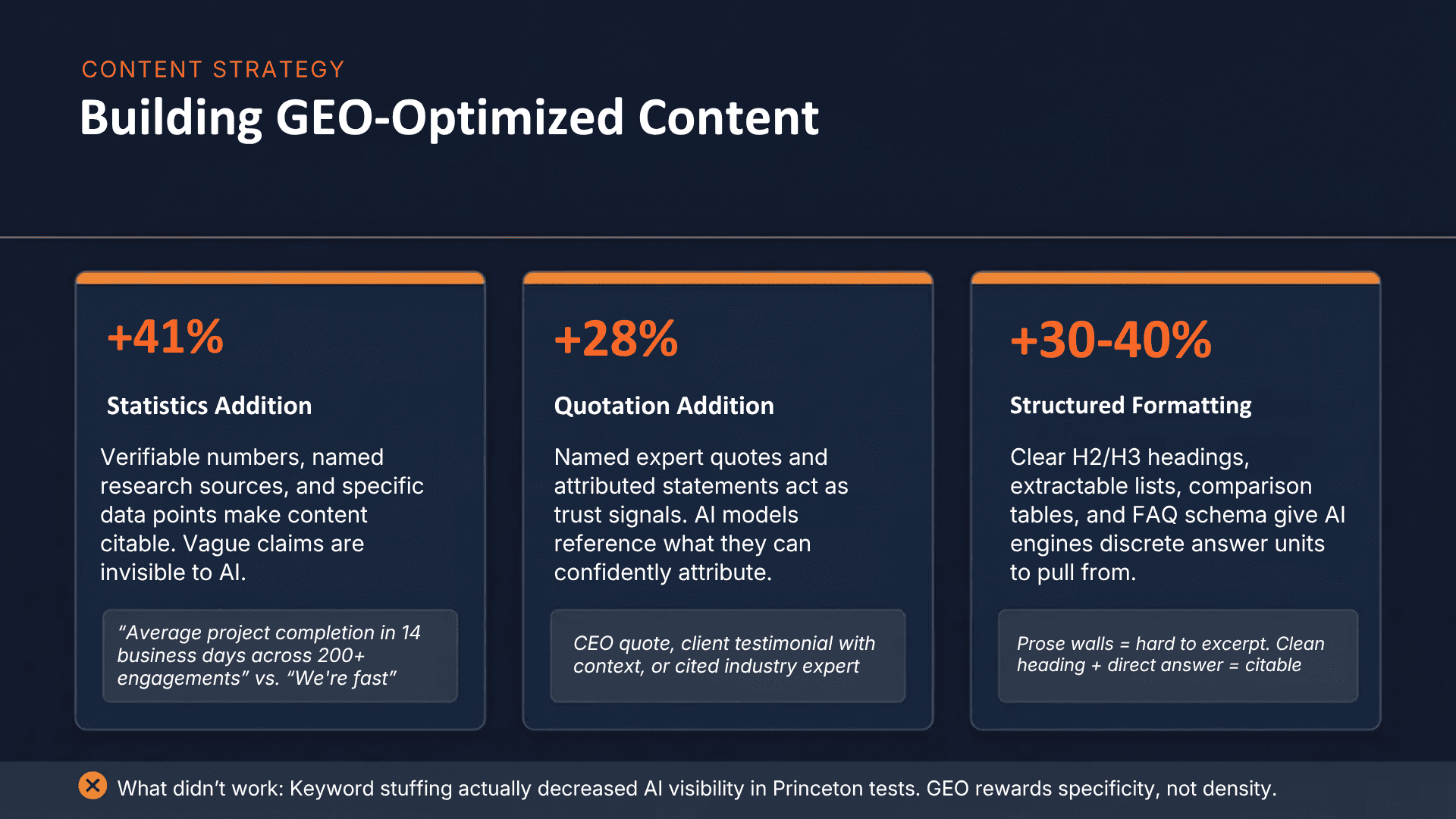
Statistics Addition: Content that includes verifiable numbers, data points, and named research sources gets cited more. Up to 41% improvement over baseline. This isn’t surprising. LLMs are trained to prefer content they can present as factual and attribute clearly. If your client’s service page says “we’re fast,” it’s invisible. If it says “average project completion in 14 business days across 200+ engagements,” it’s citable.
Quotation Addition: Including expert quotes or attributed statements improved citation rates by up to 28%. LLMs treat attributed expertise as a trust signal. Adding a named quote from the CEO, a client testimonial with context, or a cited industry expert gives the model something it can reference with confidence.
Structured Formatting: Clear H2/H3 hierarchy, extractable lists, comparison tables, FAQ blocks with schema. These give AI engines discrete answer units to pull from. A wall of prose is harder for a model to excerpt than a clean heading followed by a direct answer.
What didn’t work: keyword stuffing. It actually decreased visibility in the Princeton tests. This should put to rest the idea that GEO is just “SEO with more keywords.” It’s almost the opposite. Specificity, structure, and verifiability beat density.
For implementation, Connor Kimball’s content strategy work is worth a look if you want examples of how to structure service-industry content for both traditional and AI search. And for the technical WordPress side of making content crawlable by AI bots, WordPress Dynamics covers the performance and architecture fundamentals.
Reporting Cadence: What to Show Clients and When
GEO is a long game, but clients want short updates. Here’s a cadence that works:
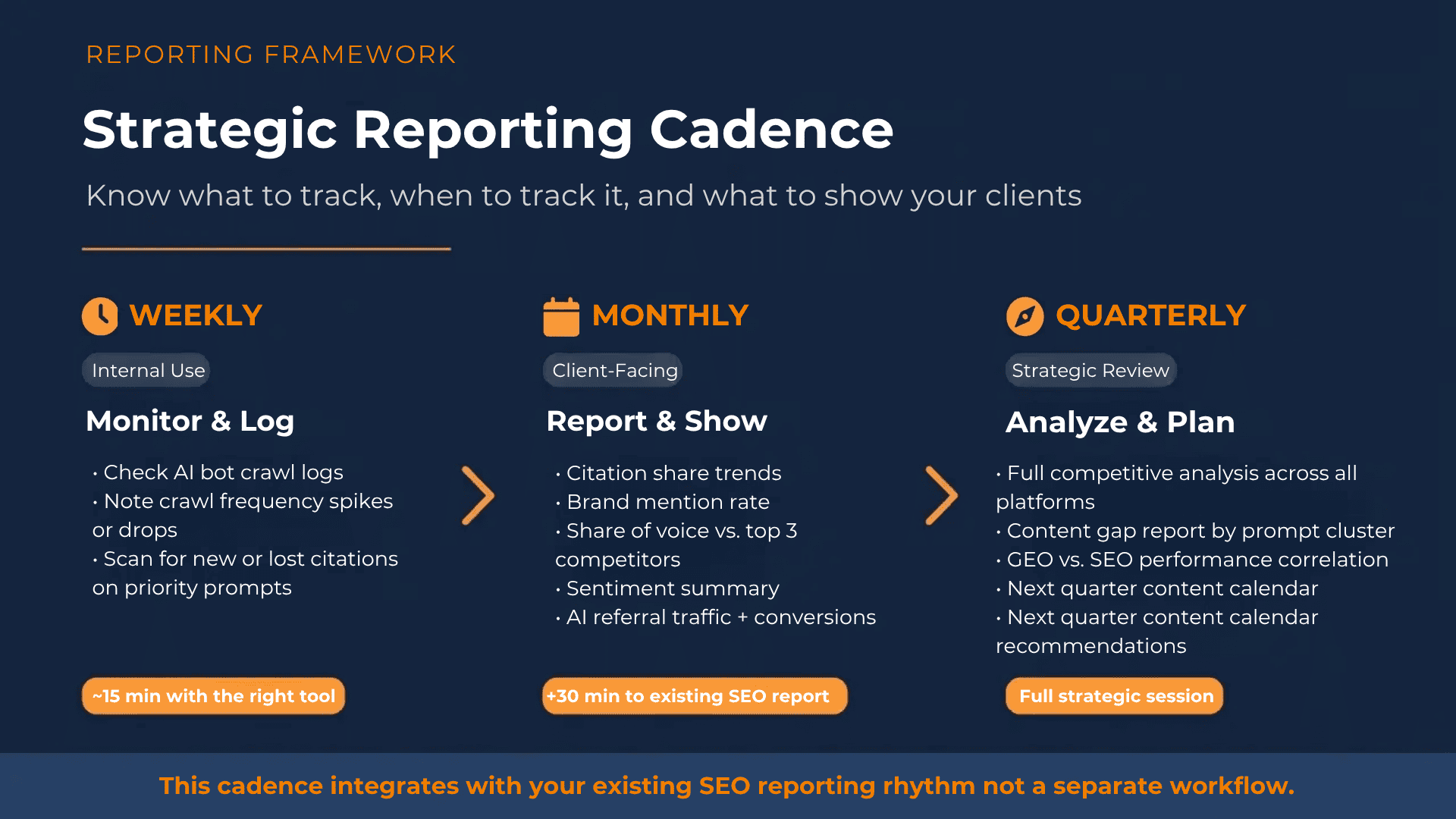
Weekly (internal): Check AI bot crawl logs. Note any spikes or drops in crawl frequency. Scan for new citations or lost citations on priority prompts. This takes 15 minutes with the right tool.
Monthly (client-facing): Report on citation share trends, brand mention rate, share of voice against top 3 competitors, sentiment summary, and AI referral traffic with conversion data. Include 2 to 3 specific examples of AI answers where the client appeared (or didn’t). Screenshots work here. Clients respond to seeing their brand in a ChatGPT answer more than they respond to a line graph.
Quarterly (strategic): Full competitive analysis across all tracked platforms. Content gap report mapping prompts with low visibility to recommended content pieces. GEO performance correlated with SEO performance to show where the two reinforce each other. Recommendations for the next quarter’s content calendar based on citation data.
This cadence integrates with your existing SEO reporting rhythm rather than creating a separate workflow. If you’re already pulling monthly reports from Semrush or Ahrefs, the GEO layer adds 30 minutes, not 3 hours.
The Industry Is Moving. Are You?
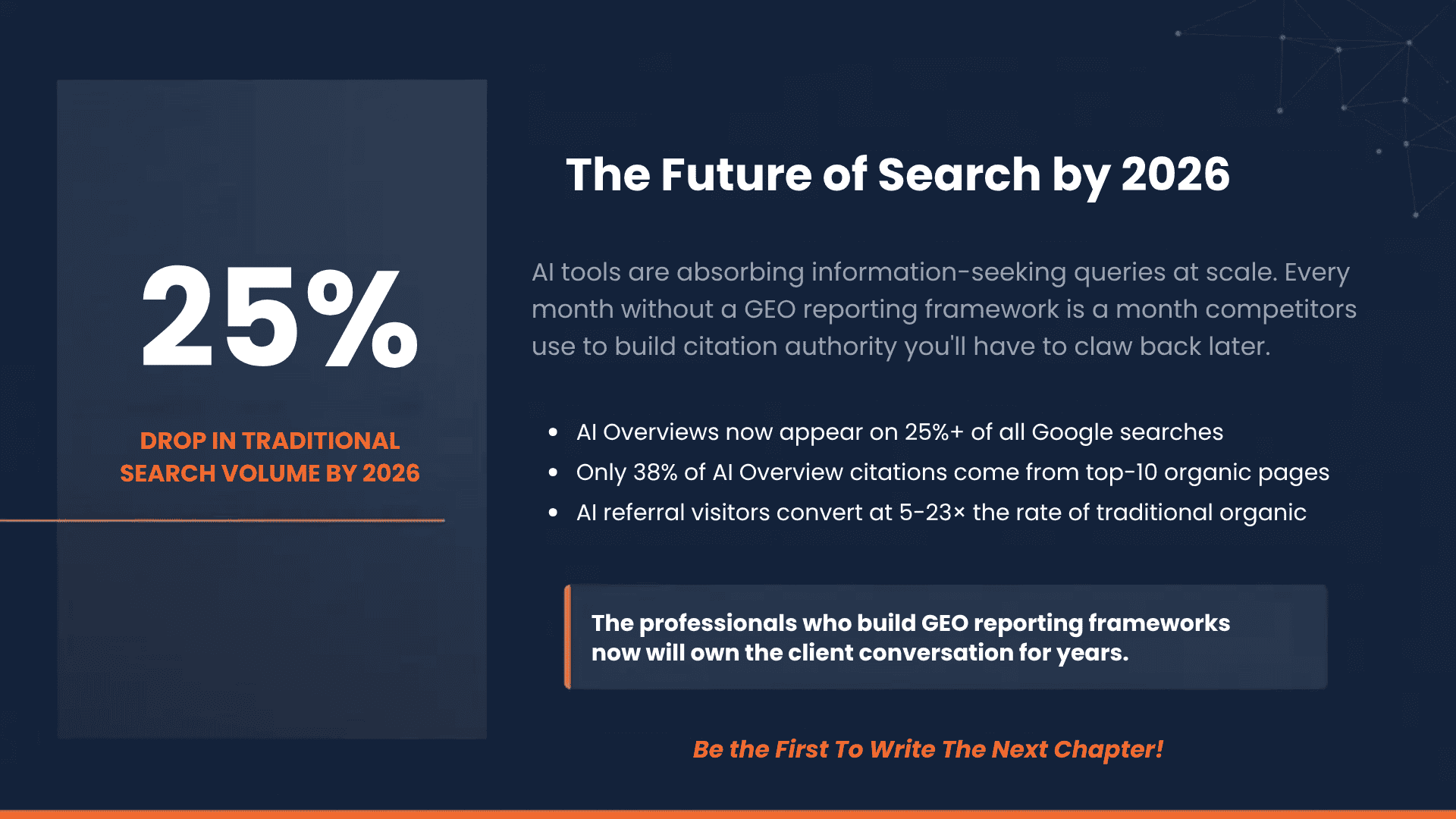
Two years ago, GEO was an academic concept in a Princeton paper. Today it’s a measurable channel with dedicated tooling, dedicated budgets, and dedicated job titles. Gartner projects that traditional search volume will drop 25% by end of 2026 as AI tools absorb information-seeking queries. AI Overviews now appear on over 25% of Google searches and climbing. Every month you wait to build a GEO reporting framework is a month your competitors use to establish citation authority you’ll have to claw back later.
The good news: the foundations are the same ones you’ve been building for years. Strong technical SEO. Clear, structured, authoritative content. Real expertise communicated with specificity. GEO doesn’t throw out the playbook. It adds a chapter.
The professionals who write that chapter first will own the client conversation. I’d rather that be you than the agency pitching against you.
Let’s Build Your GEO Reporting Stack
If you’re an SEO professional or agency looking to add GEO to your service offering, we can help. We’ll audit your current reporting, identify the gaps, and show you how to layer AI visibility tracking into your existing workflow. No 90-day ramp-up. No overpriced platform you’ll cancel in two months.
Schedule a call with us and let’s get your GEO reporting live before your competitors figure out what they’re missing.
For more on AI search strategy, The Best SEO Podcast covers these topics regularly with practitioners who are doing the work, not just writing about it.


 Follow Our RSS Feed
CONNECT WITH US!!