Google Ads vs. Facebook Ads: Definitive 2025 Guide
TL;DR This guide lays out the key differences between Google Ads and Facebook Ads (Meta Ads) to help marketers choose the right channel for their goals in 2025. Google excels at capturing high-intent searches (pull marketing), making it ideal for bottom-funnel conversions and urgent services. Facebook shines at visual storytelling and audience-based targeting (push marketing), making it strong for awareness, brand launches, or impulse purchases. The article provides a side-by-side comparison, discusses costs and ROI trends, and offers a recommended strategy: start with the platform that aligns to your funnel stage or budget, and consider using both in tandem to build a full-funnel approach.
In the ever-evolving landscape of digital marketing, two giants consistently dominate the paid advertising space: Google Ads and Facebook Ads (now Meta Ads). For businesses of all sizes, the question isn’t if you should use paid ads, but where you should spend your budget. This guide will dissect the core differences, strengths, and strategic uses of each platform to help you make the most informed decision for your business in 2025.
Table of Contents
What is Google Ads vs. Facebook Ads
The core choice is search intent vs social discovery. In 2025, the right platform depends on how buyers shop, sales cycle length, and the strength of your creative. Google captures in‑market demand with keywords, Shopping, and Performance Max, while Facebook (Meta) builds demand through audience targeting, video, and Advantage+ automation. Costs, lead quality, and time‑to‑results diverge, and privacy updates plus AI bidding raise the bar on setup, attribution, and creative testing. This guide maps clear frameworks for budgets, audience and keyword strategy, creative formats, and measurement so you can pick a winner—or run a smart split—to hit revenue targets. For a channel mix tuned to your market, request a free PPC audit.
The Fundamental Difference: Intent vs. Awareness
The most crucial distinction between Google Ads and Facebook Ads lies in their core mechanism. Understanding this is key to allocating your budget effectively.
- Google Ads = Paid Search (Capturing Demand): Google Ads primarily operates on a “pull” marketing model. You target users based on the keywords they are actively searching for. This means you’re reaching people with a pre-existing need or intent. They are looking for a solution, and your ad can be that solution. Think of it as putting your store on the busiest street where people are already looking to buy what you sell.
- Facebook Ads = Paid Social (Creating Demand): Facebook Ads operates on a “push” marketing model. You target users based on their demographics, interests, behaviors, and connections. You’re interrupting their social scrolling to introduce them to a product or service they might not have been actively looking for. Think of it as a billboard in a highly targeted neighborhood; you’re creating awareness and generating interest.
The core strategic difference: Google captures existing intent, while Facebook generates new interest.
Deep Dive: Google Ads
Google Ads, formerly Google AdWords, is the world’s largest and most popular PPC (pay-per-click) advertising platform. Its primary strength is its massive reach across the Google Search Network, Display Network, YouTube, and more.
Strengths of Google Ads
Source: Industry Averages, 2024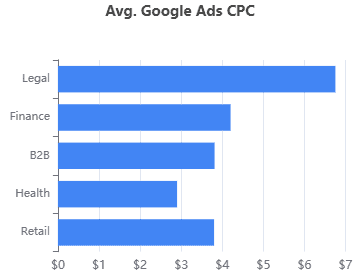
High-Intent Audience
This is the killer feature. When someone types “emergency plumber near me” or “best running shoes for flat feet,” their intent to purchase or take action is incredibly high. No other platform can match this level of immediate, problem-solving intent.
Vast Reach
With over 8.5 billion searches per day, Google is the undisputed king of search. Your potential audience is enormous. The Google Display Network also extends this reach to millions of websites, apps, and videos.
Diverse Ad Formats
From simple text ads in search results to visually compelling Shopping ads, video ads on YouTube, and banner ads on the Display Network, Google offers a format for nearly every marketing goal.
Weaknesses of Google Ads
Higher Costs for Competitive Keywords
High-intent keywords are valuable, and the auction-based system reflects that. Industries like law, insurance, and finance can see CPCs (Cost-Per-Click) soar into the double or even triple digits. This can create a high barrier to entry for small businesses.
Steeper Learning Curve
While the basics are straightforward, truly mastering Google Ads—with its match types, bidding strategies, Quality Score, and conversion tracking—can be complex and time-consuming.
Best For…
- Businesses providing immediate solutions (e.g., plumbers, locksmiths, IT support).
- Companies with a niche B2B product that people actively search for.
- E-commerce stores selling specific, known products (via Google Shopping).
- Lead generation for services with clear search intent (e.g., “divorce lawyer,” “mortgage calculator”).
Google Ads Key Takeaway
Use Google Ads when you want to be the answer to a question someone is already asking. It’s ideal for capturing bottom-of-the-funnel leads and sales from users with high purchase intent.
Deep Dive: Facebook Ads (Meta Ads)
With over 3 billion monthly active users across its family of apps (Facebook, Instagram, Messenger, WhatsApp), Meta’s advertising platform is a powerhouse for reaching a massive, diverse audience.
Strengths of Facebook Ads
Unparalleled Audience Targeting
This is Facebook’s superpower. You can target users with incredible granularity based on:
- Demographics: Age, gender, location, language, education, job title.
- Interests: Pages they’ve liked, topics they engage with (e.g., “hiking,” “vegan cooking”).
- Behaviors: Purchase behavior, device usage, travel habits.
- Custom Audiences: Target your existing customer list, website visitors (retargeting), or app users.
- Lookalike Audiences: Find new users who are similar to your best existing customers.
Visually Engaging Ad Formats
Facebook is a visual platform. This allows for highly creative and engaging ads, including images, carousels, videos, stories, and instant experiences. This is perfect for products or services that benefit from being shown off.
Lower Costs (Often)
While costs are rising, CPC and CPM (Cost-Per-Mille, or 1000 impressions) on Facebook are often lower than on Google for many industries, especially for top-of-funnel awareness campaigns. This makes it more accessible for businesses with smaller budgets.
Weaknesses of Facebook Ads
Lower Purchase Intent
You are interrupting a user’s social feed. They are there to see photos of friends and family, not necessarily to buy your product. This means you need compelling creative and a strong value proposition to grab their attention and persuade them to act.
Ad Fatigue
Because you’re targeting the same audience repeatedly, users can quickly get tired of seeing your ad. This requires you to refresh your ad creative more frequently than on Google Search.
Best For…
- Businesses with visually appealing products (e.g., fashion, home decor, food).
- Introducing a new, innovative product that people don’t know to search for yet.
- Building brand awareness and community engagement.
- Events, mobile apps, and content promotion.
- E-commerce stores looking to drive impulse buys and retarget website visitors.
“Google Ads help you find new customers, while Facebook Ads help new customers find you.”
Head-to-Head Comparison Table
| Feature | Google Ads | Facebook Ads (Meta Ads) |
|---|---|---|
| Primary Model | Paid Search (Pull) | Paid Social (Push) |
| Audience Intent | High (Actively searching for a solution) | Low to Medium (Passive browsing) |
| Targeting | Keywords, demographics, location, remarketing | Demographics, interests, behaviors, lookalikes, remarketing |
| Average CPC | Generally higher, varies wildly by industry | Generally lower, but rising |
| Ad Formats | Text, Shopping, Display (Image/HTML5), Video (YouTube) | Image, Video, Carousel, Collection, Stories, Reels |
| Best for Funnel Stage | Middle to Bottom of Funnel (Consideration, Conversion) | Top to Middle of Funnel (Awareness, Interest) |
| Learning Curve | Moderate to High | Low to Moderate |
Cost & ROI: A 2025 Perspective
It’s a common misconception that one platform is universally “cheaper” than the other. The reality is more nuanced and depends on your industry, target audience, and campaign goals.
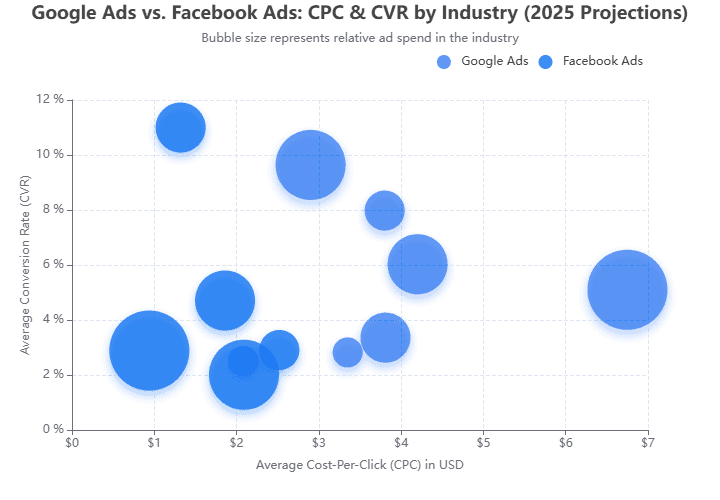
Source: Aggregated data from WordStream, Statista, and internal analysis for 2024.
The chart above illustrates the average Cost-Per-Click (CPC) and Conversion Rate (CVR) across various industries for both platforms. Key observations for 2025:
- High-Stakes Industries: Legal and Finance continue to see extremely high CPCs on Google due to the high value of a lead. Facebook offers a much lower cost of entry for brand awareness in these sectors.
- E-commerce (Retail): The battle is fierce here. Google Shopping ads often have a higher conversion rate due to intent, but Facebook’s dynamic product ads and retargeting can be incredibly effective at a lower CPC.
- Technology/SaaS: Google is excellent for targeting specific software queries (e.g., “crm for small business”), while Facebook is powerful for promoting content (like webinars or whitepapers) to a targeted professional audience.
ROI is not just about CPC. A $50 CPC on Google that leads to a $5,000 sale is far better than a $1 CPC on Facebook that leads to no sale. The key is to measure your Return On Ad Spend (ROAS).
ROAS = (Revenue from Ads / Cost of Ads) * 100%Track conversions meticulously on both platforms to understand your true ROI.
The Power of Synergy: Using Both Platforms Together
The most sophisticated marketers don’t choose one or the other; they use both in a coordinated strategy. This creates a powerful marketing flywheel that moves customers seamlessly through the funnel.
A synergistic funnel: Use Facebook for awareness and Google for capturing resulting demand.
A Common Synergistic Strategy:
- Awareness (Facebook): Run a video ad campaign on Facebook and Instagram targeting a broad but relevant audience based on interests. The goal is to introduce your brand and product.
- Interest (Facebook Retargeting): Create a custom audience of people who watched 50% or more of your video. Retarget them with a carousel ad showcasing product benefits and a clear call-to-action (e.g., “Learn More”).
- Consideration (Google Search): As users become aware of your brand, they will start searching for it on Google (e.g., “YourBrandName reviews,” “YourBrandName vs competitor”). Run a branded search campaign on Google Ads to capture this high-intent traffic and control the narrative.
- Conversion (Google/Facebook Retargeting): For users who visited your website but didn’t purchase, use both Google Display retargeting and Facebook dynamic product ads to remind them of the products they viewed and offer a small incentive to complete the purchase.
Which One is Right for You?
There’s no single right answer, but here’s a simple framework to guide your decision:
Your 2025 Action Plan
Start with Google Ads if:
- You have a limited budget and need to prove ROI quickly.
- Your product or service solves an immediate need that people actively search for.
- You are in a B2B space where decision-makers research solutions on Google.
Start with Facebook Ads if:
- You are launching a new or innovative product that has low search volume.
- Your product is highly visual and lends itself to impulse buys.
- You want to build a brand community and generate top-of-funnel awareness.
Use both if:
- You have a sufficient budget and want to build a comprehensive digital marketing funnel.
- You are in a competitive market and need to reach customers at every stage of their journey.
- You are serious about scaling your business and maximizing your market share.
Need Help with Your Ad Strategy?



 Follow Our RSS Feed
CONNECT WITH US!!