

By Phil Belleville | Omaha SEO
I’ve been helping small businesses rank online since 1995. Back then, the biggest challenge was getting a website indexed. Today, the challenge is making sure AI engines recommend you when a customer asks “who’s the best [your service] near me.”
This page is for the person who needs a GEO API or an AEO API, not another dashboard login. I tested these platforms for custom reports, mostly for local clients. The ranking is about API access, not which chart looks best in a demo.
Table of Contents
Typical issues with AEO / GEO platforms offering API access
Few API-first tools to choose from
Most new AI visibility tools were built as a web app. API access showed up later. Legacy suites such as Semrush have a large data set and a slow path to a clean API on top of it.
The limit I hit most often is read-only access. I need read and write when a report has to create prompts, update a client project, or push a bulk change. A key that can only export yesterday’s table is not an integration.
Overpriced
Peec AI, Scrunch AI, and Profound are the well-funded names that talk about an API. In my testing, the API was not on the plan you can buy and try. It sat on an enterprise tier. That means several hundred dollars a month, sometimes a custom quote, before you can see if the endpoints fit a custom report.
A dashboard at that price can still be useful. It is a bad place to start if the job is an AEO API.
Missing a metric I actually use
Most of my clients are local. A GEO API that cannot track a city or a service area is a weaker fit. I also want the surfaces I already use in delivery: YouTube, and Google Maps or the local pack, not only ChatGPT.
Citations and brand mentions are different numbers. Tools that blend them into one score make a custom report harder to explain.
What I needed
AI visibility metrics
- Custom prompt tracking in the main models, especially Google AI Overviews and ChatGPT
- Citations and brand mentions as separate fields
- Geographic prompt tracking
- YouTube, when the platform has it
- Recommendations that point at a page or a gap, not a generic score
Read and write access, and MCP
Read access is the export. Write access is creating or updating prompts, projects, and reports from my own system. MCP is the same data behind an assistant: Claude, ChatGPT, or Cursor can query the account in plain language and, if the server allows it, run bulk updates. If a vendor has an API and no MCP, I can still build. If they have neither on a normal plan, I cannot.
Developer docs
I want a base URL, auth, an example call, and a list of endpoints that matches the product. A PDF that says “contact sales for the schema” is not docs.
Best API-based reporting tools I have tried
Cairrot (best overall AEO / GEO API)
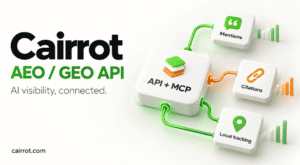
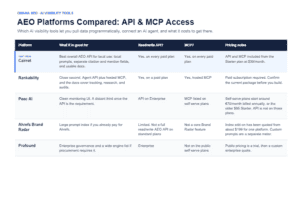
Cairrot is first because the API and MCP are on the plan I already use, not on a sales call. Their developer page says API access is included on Starter at $39/month, with no separate API meter, and that citations and mentions can be pulled as separate metrics. MCP is on every paid plan and can run bulk updates from Claude, ChatGPT, or Gemini. The connection guide lists the server at https://api.cairrot.com/api/v1/mcp. Docs: API + MCP for AEO/GEO and SEO. Claude setup: How to connect Cairrot to Claude with MCP.
For local work, prompt tracking includes geography, ChatGPT, and Google AI Overviews. YouTube and Reddit views sit in the same account, which is the delivery stack I already use. I wrote the longer product review here: Cairrot Evaluation (2026).
Rankability (close second)
Rankability is the other tool in this set with a real Agent API and a hosted MCP endpoint (https://app.rankability.com/mcp). The help center documents read paths for visibility, tracking, research, and audits, plus write-style jobs for content and outreach. MCP is included with the same plan entitlement as the app, not a separate enterprise key. Getting started: Rankability API and MCP.
I rank it second because the docs are solid and the API is not a rumor. I still use Cairrot when the report has to stay cheap per local client and when I want citations and mentions split without a higher tier.
Peec AI (distant third)
Peec is a reasonable monitoring product. Unlimited seats and a choice of models on the self-serve plans are why teams buy it. It is third here because the API I needed was still on Enterprise when I reviewed it. Peec’s own comparison pages list MCP on standard plans and API plus SSO on Enterprise. Self-serve pricing has moved; public pages have shown about $95/month and, later, about €70/month billed annually for the entry tier. Full write-up: Peec AI review.
Ahrefs Brand Radar
Brand Radar is the add-on if you already live in Ahrefs and want a large prompt index next to backlink data. It is not the GEO API I would start a custom integration on. Access to anything like an API has been limited or enterprise in my testing. The index has been sold per platform, with a single-platform index around $199/month and a broader bundle higher. Review: Ahrefs Brand Radar review.
Profound
Profound is the enterprise option: governance, a wider engine list on the custom plan, and an API that sales quotes. Public pricing is a short trial, then a custom contract. I do not use it for a local WordPress client. The tracker comparison is here: 9 best AEO trackers.
Other technical notes on this site
- How to track and rank in LLMs
- What are the best tools to generate SEO reports?
- WordPress SEO and AEO for local service businesses
Get GEO visibility work done with a local operator
If you want the reporting stack set up, or you want someone else to run the campaign, book from omaha-seo.com. Bring the site URL and the competitors you actually lose work to.


 Follow Our RSS Feed

CONNECT WITH US!!