
The digital marketing landscape is undergoing a seismic shift. The rise of AI-powered search, from Google’s AI Overviews to standalone platforms like Perplexity and ChatGPT, has introduced a new paradigm: Answer Engine Optimization (AEO). To win in this new era, marketers must evolve, adopting a hybrid approach that builds upon proven SEO principles while embracing new, AI-focused optimizations. This isn’t about replacing SEO; it’s about enhancing it for a world where users seek direct answers, not just lists of links.
Research confirms we are living in a “hybrid, two-channel world.” While AI referral traffic is growing, traditional organic search still commands a significant share of traffic, accounting for as much as 42.4% in sectors like Health Care. Therefore, a successful AEO program is an evolution, one that requires a strategic, multi-faceted approach. Here are the core pillars that form the foundation of a winning AEO strategy.
Table of Contents
Your Strategic AEO Blueprint
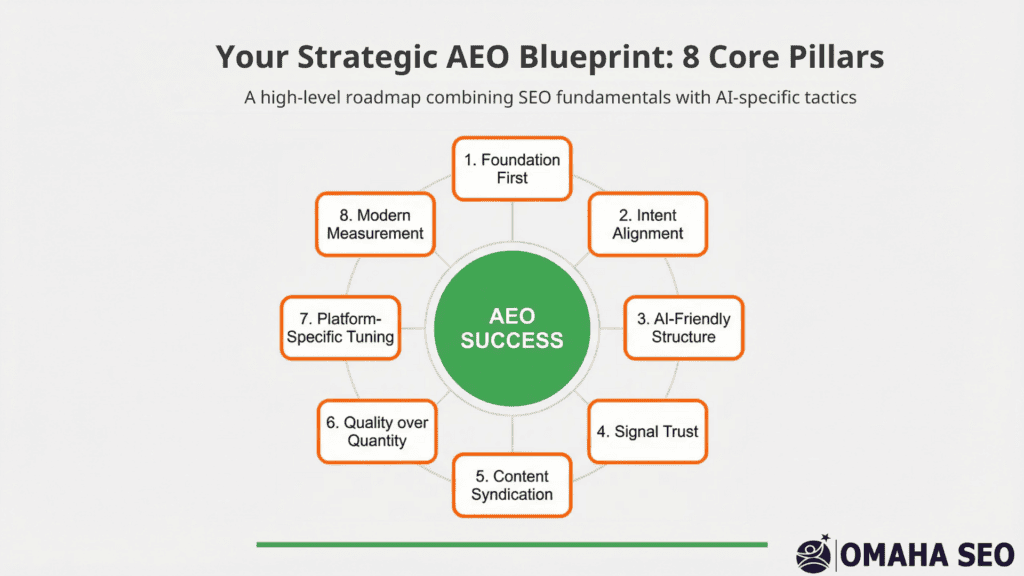
To effectively navigate this new terrain, your strategy must be comprehensive. It involves reinforcing your existing digital assets while simultaneously adapting them for how Large Language Models (LLMs) discover, process, and present information. The following steps provide a high-level roadmap for building a robust AEO program:
- Foundation First: Solidify and build upon your core SEO fundamentals.
- Intent Alignment: Shift content strategy to focus on conversational queries and user intent.
- AI-Friendly Structure: Update on-page elements to be easily parsable by AI models.
- Signal Trust: Double down on demonstrating Experience, Expertise, Authoritativeness, and Trustworthiness (E-E-A-T).
- Content Syndication: Repurpose and distribute content across multiple high-authority platforms.
- Quality over Quantity: Prioritize content freshness, depth, and engagement.
- Platform-Specific Tuning: Implement LLM-specific adjustments for targeted visibility.
- Modern Measurement: Evolve your KPIs to track what matters in AEO, such as prompt visibility and AI-driven traffic.
AEO Strategy Checklist
Understanding the high-level steps is the first part of the journey. Now, let’s explore each pillar in detail to understand the specific tactics required for successful implementation.
1. Build on SEO Fundamentals, Don’t Abandon Them
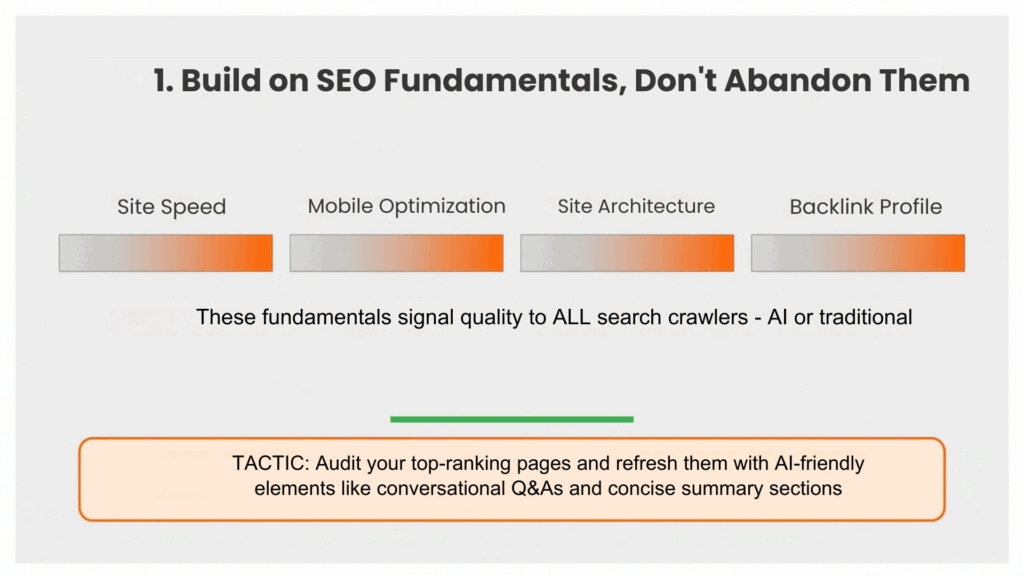
First and foremost, do not abandon your core SEO practices. AI search engines, including Google’s AI Overviews, still rely heavily on the same signals that traditional search has used for years to determine authority and relevance. Factors like **site speed, mobile optimization, a logical site architecture, and a healthy backlink profile** are prerequisites for both SEO and AEO success. These fundamentals signal quality and reliability to all search crawlers, AI or otherwise. AEO should be treated as an evolution of your SEO efforts, not a replacement.
Tactic: Audit your top-ranking pages—the ones already validated by Google as authoritative—and refresh them with AI-friendly elements like conversational Q&;As and concise summary sections. This enhances your most valuable existing assets rather than starting from scratch.
2. Optimize for Conversational Queries and Search Intent
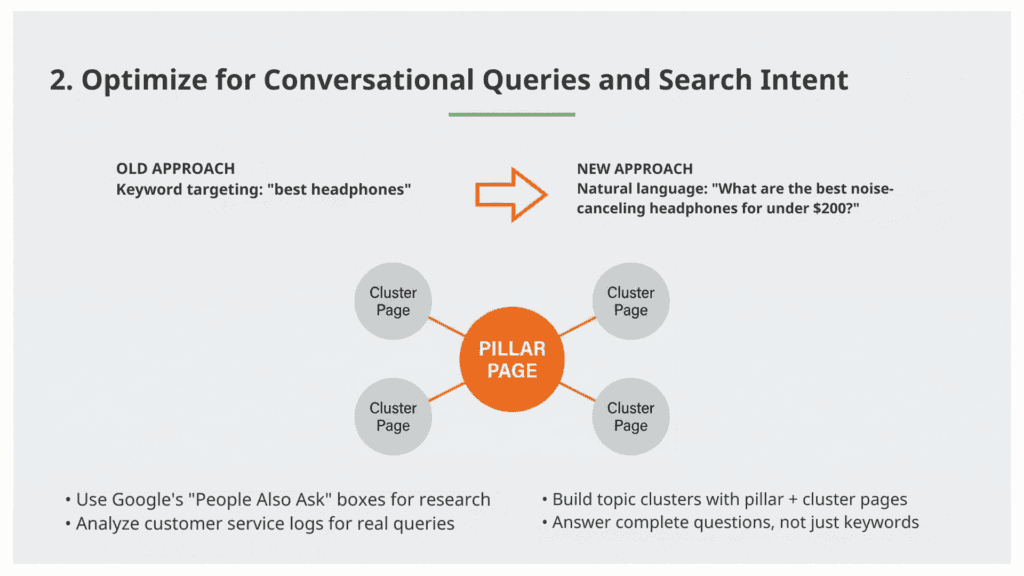
The most significant shift in content strategy for AEO is moving from targeting fragmented keywords to answering complete, **conversational questions**. Users interact with AI assistants using natural language, asking, “What are the best noise-canceling headphones for under $200?” instead of typing “best headphones.” Your content must directly address these detailed queries to be considered a candidate for citation in an AI-generated response. Use tools like Google’s “People Also Ask” (PAA) boxes and your own customer service logs to identify the exact questions your audience is asking.
Tactic: Build topic clusters around core subjects. Create a central pillar page that provides a broad overview, then surround it with cluster pages that answer specific, long-tail questions. This structure demonstrates **comprehensive expertise** to AI models, making your domain a go-to source for a given topic.
3. Update On-Page SEO for AI Parsers
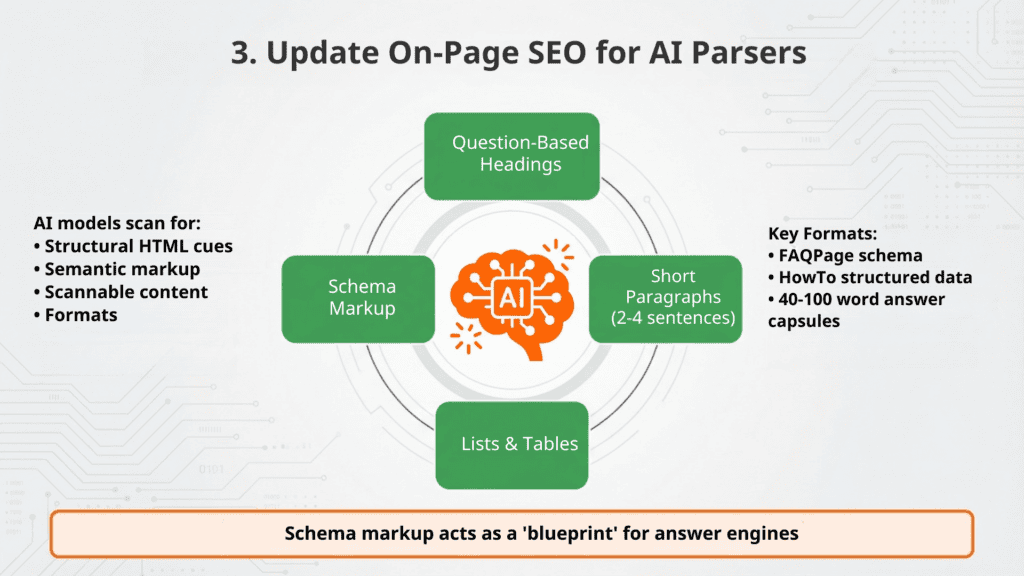
AI models are not patient readers; they are **efficient information parsers**. They scan HTML for structural and semantic cues to quickly extract and synthesize information. To make your content easy for AI to digest, use clear, scannable formats:
- Headings (H2, H3): Phrase headings as direct questions (e.g., “How Do You Implement Schema Markup?”).
- Lists & Tables: Use bullet points, numbered lists, and tables to break down complex information into digestible points and comparisons.
- Short Paragraphs: Keep paragraphs to 2-4 sentences to avoid dense walls of text.
- Answer Capsules: Begin articles or key sections with a concise, 40-100 word summary that directly answers the main question.
Furthermore, implementing **schema markup (structured data)** is critical. Schema acts as a “blueprint” for answer engines, giving them explicit context about your content (e.g., FAQPage, HowTo, Article). This dramatically increases the chances your content will be interpreted correctly and featured.
4. Emphasize E-E-A-T to Trigger Expertise Signals
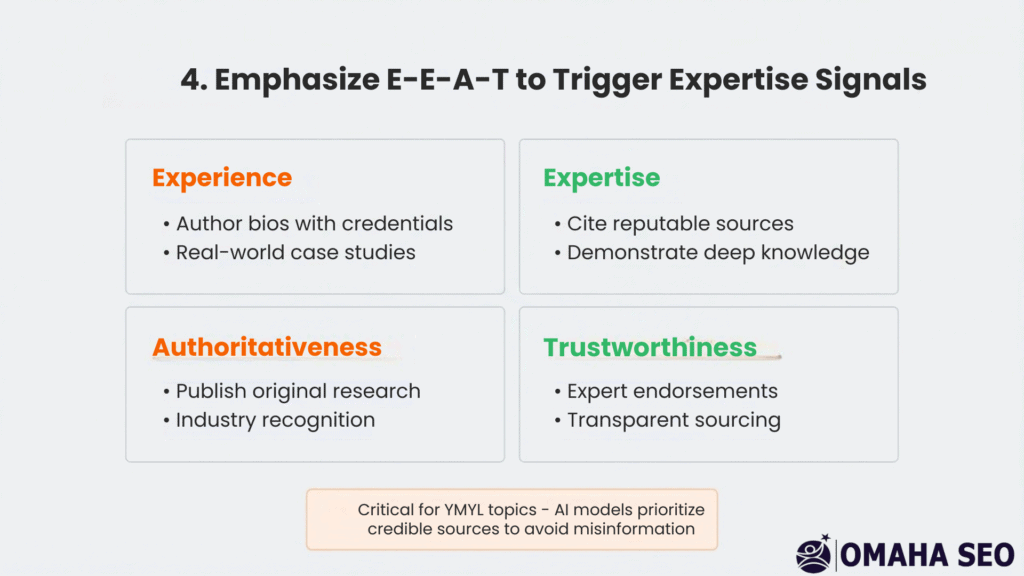
E-E-A-T (Experience, Expertise, Authoritativeness, and Trustworthiness) is Google’s framework for content quality, and it’s more critical than ever for AEO. AI models are designed to prioritize credible, trustworthy sources to avoid propagating misinformation, especially for “Your Money or Your Life” (YMYL) topics. Demonstrate E-E-A-T by featuring author bios with credentials, citing reputable sources, publishing original data from surveys or research, and securing expert endorsements. This builds a moat of credibility around your content that AI is programmed to respect.
5. Repurpose Content on Several Websites (Build on Rented Land)
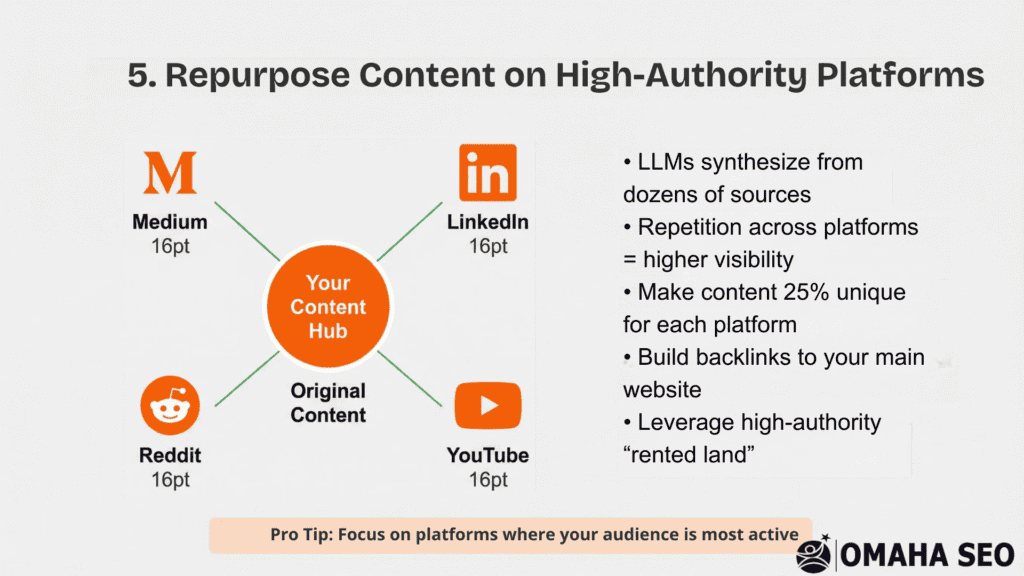
LLMs synthesize information from dozens of web results. This means **repetition and widespread presence are key** for staying visible. Don’t just publish content on your own website. Reformat that content and make it available on several high-traffic websites and UGC platforms. Platforms like Medium, LinkedIn Pulse, Reddit, and YouTube are excellent choices, as they are frequently crawled and trusted by various LLMs. This tactic ensures your brand’s message and expertise are encountered multiple times by an AI agent researching a user’s query, reinforcing your authority.
Tactic: Take a core piece of content, rewrite it to be at least 25% unique, and publish it on third-party sites with a link back to a relevant article on your own website. This builds both visibility and a diverse backlink profile.
6. Prioritize Engagement and Freshness Over Volume
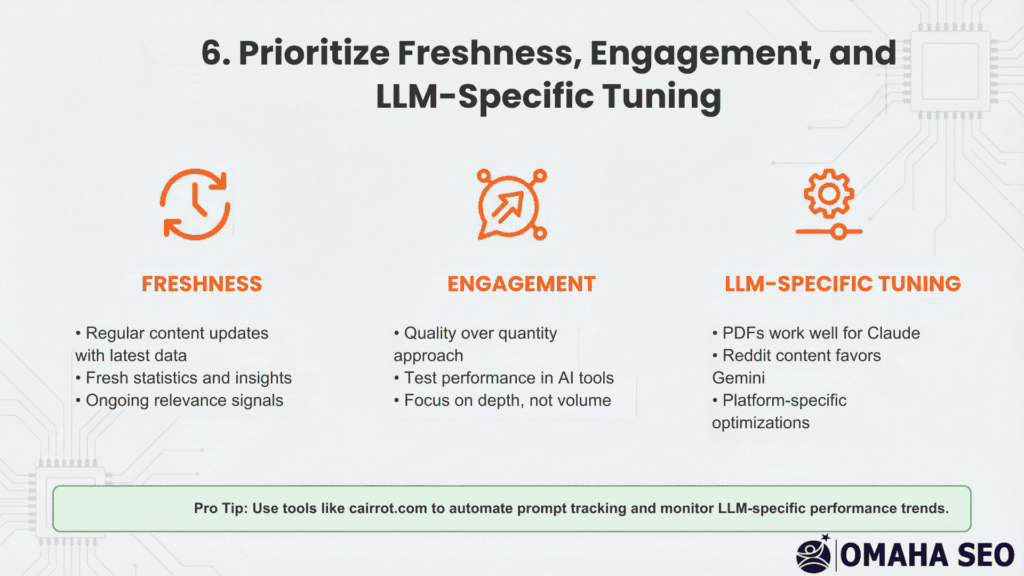
The AEO era rewards depth and relevance, not sheer volume. The goal is to enhance a few high-quality, comprehensive pieces rather than churning out thin content. AI models favor content that is **up-to-date and thorough**. Regularly refresh your key articles with the latest statistics, facts, and insights to maintain their “freshness” score and signal ongoing relevance. Instead of just tracking traffic, test your content’s performance directly in AI tools by querying them with your target prompts and tracking citation frequency and brand mentions.
Pro Tip with cairrot.com: Manually testing prompts across multiple LLMs is time-consuming and difficult to scale. Tools like cairrot.com automate this process, allowing you to continuously monitor your visibility for key prompts, track citation frequency, and analyze the sentiment of how your brand is mentioned in AI responses. This provides the actionable data needed to effectively prioritize your content refresh strategy.
7. Add LLM-Specific Adjustments to Your Strategy
Not all LLMs are the same. They have different training data, architectures, and content preferences. Winning in AEO requires a nuanced approach that accounts for these differences. For example, some analyses show that Claude may favor content in PDF format, Gemini often surfaces information from Reddit discussions, and setting up Bing Webmaster Tools can increase your likelihood of being surfaced by Microsoft Copilot and ChatGPT.
Staying on top of these trends is a significant competitive advantage. This is where specialized tools become indispensable. AI visibility platforms like cairrot.com are designed to reveal these trends across every major LLM, making it easier to see which tactics are most effective for specific platforms. This allows you to make **data-driven, LLM-specific adjustments** to your SEO strategy, putting you far ahead of competitors who are still using a one-size-fits-all approach.
8. Stay Focused on Modern KPIs
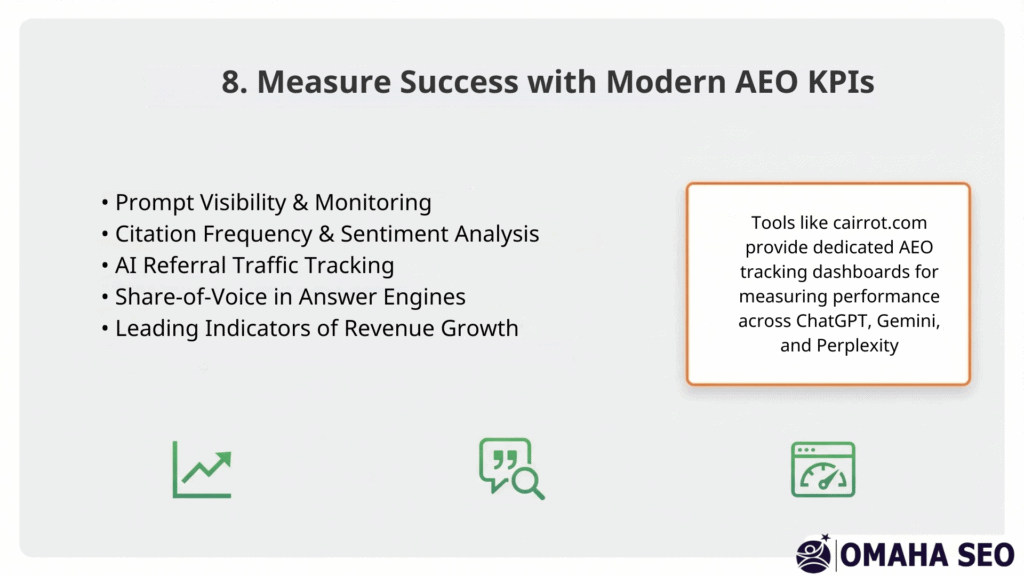
For traditional SEO, success was measured by keyword rankings and organic traffic. For modern AEO teams, the goalposts have moved. AEO KPIs have to account for “Visibility” metrics within LLMs. This means shifting focus to:
- Prompt Tracking & Visibility Monitoring: Are you being cited for the most important user queries in your industry?
- AI Referral Traffic: How much traffic is coming from AI Overviews and other answer engines?
- Citation Frequency & Sentiment: How often are you mentioned, and is the context positive?
While anyone can check their AI traffic in Google Analytics, true performance measurement requires dedicated tools. AEO trackers like Cairrot are now used to “rank track” your position and visibility within LLMs like ChatGPT, Gemini, and Perplexity, providing the critical leading indicators of future revenue growth. See my opinion on Cairrot and 9 other top rated AI visibility tools if you’re interested.
AEO Strategy & Tactics Recap
To help you organize your efforts, the following table details the objectives and key tactics for each pillar of your AEO strategy.
| Strategic Pillar | Objective | Key Tactics |
| 1. SEO Fundamentals | Establish a technically sound and authoritative foundation for all search crawlers. | Optimize site speed, mobile-friendliness, site architecture, and backlink profile. |
| 2. Conversational Queries | Align content directly with the natural language questions users ask AI. | Build topic clusters; use PAA and customer logs for research; answer questions directly. |
| 3. On-Page for AI | Make content easily scannable and interpretable for AI parsers. | Use question-based headings, lists, tables, short paragraphs, and schema markup (FAQPage, HowTo). |
| 4. E-E-A-T Signals | Build and demonstrate credibility to be prioritized as a trustworthy source. | Feature author bios, cite authoritative sources, publish original data, get expert reviews. |
| 5. Content Syndication | Increase brand and content visibility across the web to maximize citation probability. | Repurpose and publish content on Medium, LinkedIn, Reddit, and industry partner sites. |
| 6. Freshness & Engagement | Signal ongoing relevance and authority to AI models. | Regularly update key articles with new data; monitor performance in AI tools. |
| 7. LLM-Specific Tuning | Optimize for the unique preferences of different answer engines. | Analyze LLM-specific trends (e.g., PDFs for Claude, Reddit for Gemini) and adapt content formats. |
| 8. Modern KPIs | Measure what matters for AEO to prove value and guide strategy. | Track prompt visibility, citation frequency, and AI referral traffic. |
Get Help With Your AEO Strategy
Answer Engine Optimization is the natural evolution of search marketing and we at Omaha SEO are on the cutting edge of AI search optimization for businesses like yours. It requires a strategic blend of timeless SEO fundamentals and new, AI-centric tactics. By focusing on these core pillars—from building on a solid technical foundation to measuring performance with modern KPIs—you can position your brand to thrive in this new landscape.
However, in a competitive environment, strategy alone is not enough. The ability to execute with precision, adapt to platform-specific nuances, and measure what truly matters is what separates leaders from the rest.



 Follow Our RSS Feed
CONNECT WITH US!!